
Palermo isn’t just a city – it’s a feeling. With your very first breath of air you realise that here the Mediterranean isn’t the backdrop but the main character. The scent of salt, jasmine and freshly made cannoli mingles with the voices from the street markets and the distant buzz of scooters cutting through the narrow streets. Palermo is chaotic, colourful, alive – a city that doesn’t try to be tidy, because its beauty lies precisely in its authenticity.
Set on the north-western coast of Sicily, between Monte Pellegrino and the turquoise Tyrrhenian Sea, Palermo bears the marks of every civilisation that has touched it – Phoenicians, Arabs, Normans, Spaniards. Here you’ll discover golden mosaics that shine like the sun over the island, Baroque façades that tell of grandeur and decline, and markets where time seems to have stopped centuries ago. This is a city where cultures don’t simply coexist – they intertwine into one inexplicable, magnetic whole.
But Palermo isn’t only history. It’s an emotion to be savoured slowly – with a glass of Aperol at sunset, with an aimless wander through its neighbourhoods, with a glance at the washing fluttering between the balconies like a flag of everyday life. This is a place where you’ll feel the real Sicily – raw, warm, a little rebellious and endlessly charming. In the lines that follow I’ll take you through the most beautiful corners of this southern masterpiece – a city you don’t just visit, but experience.
In this article I’ve gathered the top 15 most interesting sights in Palermo, along with some tips that will make your stay there even more exciting and interesting.

How to get there?
Travelling to Palermo is now easier than ever. Wizz Air has launched direct flights from Sofia to Palermo, making Sicily even more accessible. The flight lands at Aeroporto di Palermo Falcone e Borsellino, located about 35 km west of the city.
There are several ways to get from the airport to the centre. The train is a convenient and relatively fast option – the journey to Palermo Centrale takes about 50 minutes. Buses are also frequent and affordable. A taxi is more expensive but convenient, especially if you arrive late in the evening. If you’re planning to explore other parts of Sicily as well, hiring a car straight from the airport will give you complete freedom.
An alternative option is a flight to Catania, especially if you find more convenient times or a better price. From there, Palermo is about 2.5–3 hours away by hire car. The road crosses the island’s interior – dry golden hills, olive groves and panoramas that reveal Sicily’s rugged beauty.
When to visit Palermo?
Spring (April–June) is one of the most beautiful times to visit. Temperatures are pleasant, around 20–25°C, and the city is full of light. It’s the ideal season for exploring historic sites and for long walks without being worn out by the heat.
Autumn (September–October) is also an excellent choice – the sea stays warm and the tourist crowds thin out. Summer is the liveliest season – July and August bring real Mediterranean heat, but also an incredible atmosphere, especially by the sea. Winter is mild and calmer, suited to cultural tourism without the crowds.
Where to stay?
The area you choose in Palermo largely determines how you’ll experience the city. If you want to be right at its heart – among Baroque façades, street markets and small family-run trattorias – the historic centre is the best choice. The areas around the Cathedral, Quattro Canti and Via Maqueda put you within walking distance of the main sights and let you feel the true rhythm of the city – from the morning coffee to the late Sicilian evenings.
If you prefer a little more calm and elegance, head for the area around Teatro Massimo and the Politeama district. Here the atmosphere is more orderly, the streets are wider, and the 19th-century buildings lend a sense of old European grandeur. It’s a great choice for those who want a balance between a central location and comfort.
For those looking for a real seaside break, the resort area around Mondello Beach offers a different experience. There the day begins with a view of the turquoise water, and the evenings are quieter and refreshed by the sea breeze. The villas and boutique hotels around Monte Pellegrino combine nature, panoramic views and tranquillity – ideal for a longer stay or a romantic getaway.
How to get around?
Palermo is a city best discovered on foot. The historic centre is compact, and the distances between the main sights are perfectly manageable for a slow, contemplative stroll. That’s exactly how you’ll feel the real atmosphere – you’ll hear the conversations drifting from open windows, discover little family-run cafés and stumble upon hidden courtyards that don’t appear on the tourist maps.
For more distant spots, the city has a bus network and tram lines connecting the centre with the newer districts. If you’re planning a visit to Mondello Beach or a drive up Monte Pellegrino, a car will give you more freedom and flexibility. Taxis are also a convenient option, especially in the evening, when you want to get back comfortably after a long Sicilian dinner.
Which local dishes to try?
Palermo is one of Europe’s street-food capitals. Here gastronomy isn’t just part of the culture – it’s daily life, ritual and pride. A stroll through the Ballarò or Vucciria markets is a true culinary experience – the aromas of frying, spices, fresh fish and warm bread mingle in the air, and the local vendors invite you to try “just one piece”.
Be sure to start with arancini – crispy rice balls filled with ragù, cheese or pistachio. They’re a symbol of Sicily and you’ll find them everywhere. Also try panelle – fried chickpea-flour fritters served in a sandwich, surprisingly tasty and light. Another typical dish is sfincione – the Sicilian version of pizza, thicker and generously topped with tomato sauce, onion and cheese.
If you want to taste the island’s deeper flavours, go for pasta con le sarde – pasta with sardines, fennel, raisins and pine nuts, which combines sweet and savoury in a typically Arab-influenced way. Caponata – a dish of aubergine, tomatoes, olives and capers – is another classic flavour you’ll come across in almost every trattoria.
And to finish – the desserts. Cannoli with ricotta and pistachio cream are an absolute classic, while the traditional cassata siciliana is a true explosion of almond marzipan, ricotta and candied fruit. In Palermo food isn’t eaten in a hurry – it’s shared, discussed and savoured.
What to see in Palermo?
Palermo Cathedral (Cattedrale di Palermo)
Palermo Cathedral isn’t just a religious building – it’s Sicily’s history in concentrated form. Built in 1185 on a site where an early Christian basilica and, later, a mosque during Arab rule once stood in turn, the cathedral is living proof of the island’s cultural layers. Its façade looks almost fantastical – Arab decorative motifs, Gothic arches and towers added in different periods create the feeling that the building was sculpted by several civilisations at once.
Inside you’ll find the royal sarcophagi of the Norman rulers, among them Roger II and Emperor Frederick II – one of the most learned and enigmatic figures of the Middle Ages, who spoke several languages and was a patron of the sciences. Climbing up to the roof is an experience in itself – from there a panorama opens up over the old town, the domes, Monte Pellegrino and the sea. This is the moment when Palermo arranges itself before you like a historical mosaic.
Entrance fee: around €7 (combined ticket with access to the roof and the tombs)
Useful tip: If you want peace and quiet and time for photos without the crowds, choose a weekday before 10:00 or about an hour before closing. The combined ticket is worth it above all for the panoramic terrace — from there you’ll get the best orientation of the whole city.

The Royal Palace and the Palatine Chapel (Palazzo dei Normanni e Cappella Palatina)
The Royal Palace is one of the oldest royal palaces still in use in Europe. Its foundations were laid back during Arab rule, but its present appearance took shape under the Normans in the 11th–12th centuries. Today the building is the seat of the Sicilian Regional Assembly – a symbolic continuation of its political role through the centuries.
The real gem, though, is the Palatine Chapel. When you step over its threshold, it’s as if you’re entering a golden universe. Byzantine mosaics cover the walls and the dome with biblical scenes, while the Arab wooden ceiling is decorated with exquisite geometry and calligraphic motifs. An interesting fact is that this space was created as a demonstration of harmony between different cultures – Byzantine, Latin and Islamic. Few places in Europe show this coexistence so clearly.
Entrance fee: around €15
Useful tip: In the chapel, stand for a few minutes in the centre beneath the dome and simply look up — the golden mosaics have their most powerful effect when the light falls at a certain angle. If you’re visiting at the weekend, book your ticket online to avoid queuing.

The Church of San Giovanni degli Eremiti (San Giovanni degli Eremiti)
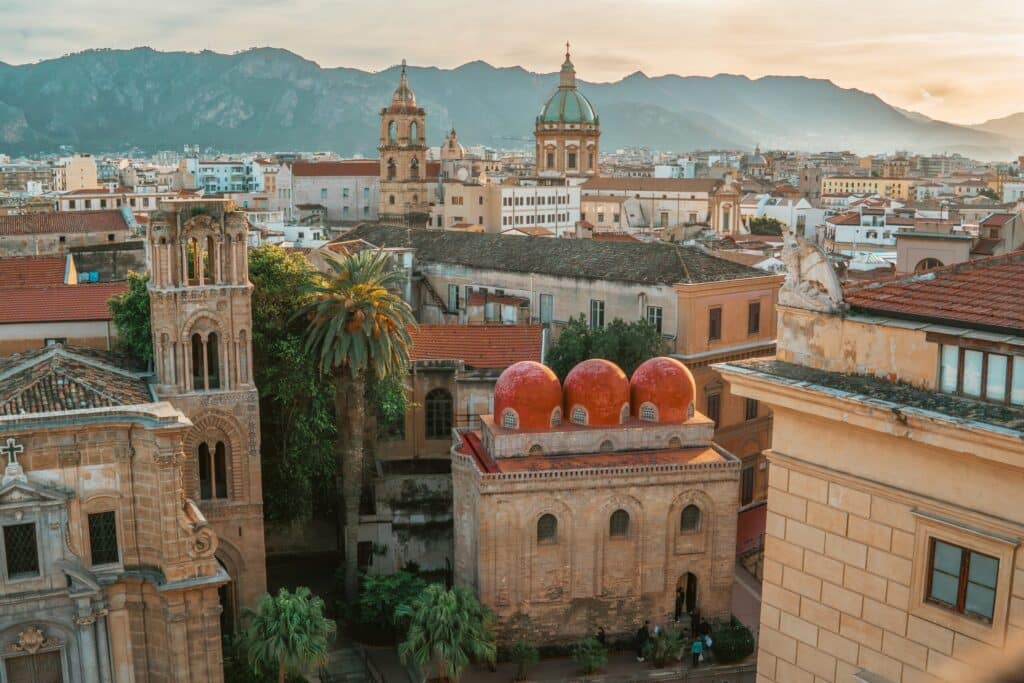
San Giovanni degli Eremiti is one of the most photographed churches in Palermo thanks to its distinctive red domes. Built in the 12th century, it is an example of Arab-Norman architecture – a style born right here in Sicily. Its domes recall Islamic traditions, while its stone walls speak of Norman austerity.
The cloister is a quiet refuge of palms and arches that create the feeling of a southern oasis. A curious fact is that the red colour of the domes isn’t original – they were painted in the 19th century to emphasise the building’s oriental character and heighten its visual impact.
Entrance fee: around €6
Useful tip: Take your time in the cloister — that’s where the oriental influence is felt most strongly. It’s a wonderful spot for a short break from the noise of the city, especially if you combine it with a visit to the nearby palace.

La Martorana Church (Chiesa della Martorana / Santa Maria dell’Ammiraglio)
La Martorana is among the most impressive Byzantine churches in Italy. Founded in 1143 by Admiral George of Antioch, it dazzles with its golden mosaics, which shine even in dim light. The central dome depicts Christ Pantocrator – a classic Byzantine image that dominates the space.
One of the most interesting scenes inside shows Christ crowning King Roger II – a rare example of religious art affirming secular power. Over the centuries the church has undergone various architectural alterations, which makes it all the more complex and interesting to explore.
Entrance fee: around €3
Useful tip: Before going in, take a minute to look at the façade and the square around it — the contrast between the Baroque exterior and the Byzantine interior makes the experience all the more striking. Check the opening hours in advance, as it often closes over lunchtime.

The Church of San Cataldo (San Cataldo)
San Cataldo is small in size but powerful in impact. Its three red domes have become one of the symbols of Palermo. Built in the 12th century, it is an example of pared-back Arab-Norman architecture without superfluous decoration.
The interior is almost ascetic – stone walls, simple arches and a minimalism that creates a special sense of silence and spirituality. It’s precisely this simplicity that makes the place so moving after the opulence of other churches in the city.
Entrance fee: around €2.50
Useful tip: Visit it straight after La Martorana to feel the strong contrast between opulence and minimalism. It’s this very sequence that makes the impression deeper.

Piazza Pretoria (Piazza Pretoria)
Piazza Pretoria is one of those places where Palermo reveals its theatrical side. At its centre stands the monumental Fontana Pretoria, created in the 16th century in Florence and later brought to Sicily – dismantled into hundreds of pieces and transported by sea. The fountain is adorned with dozens of marble figures – gods, nymphs, allegories and animals – arranged on several levels.
When it was unveiled, the locals called it the “Square of Shame” because of the nudity of the statues, which seemed scandalous for the time. Today it’s one of the most photogenic spots in the city, surrounded by churches and historic buildings. Here you’ll often see newlyweds, artists and tourists stopping for a photo amid the stone symmetry and the Sicilian light.
Entrance fee: Free
Useful tip: Climb the steps of the square and look at the fountain from different angles — the details of the sculptures reveal themselves gradually. The best photos are taken when the light falls from the side rather than directly from above.

The Antonio Salinas Regional Archaeological Museum (Museo Archeologico Regionale Antonio Salinas)
The Antonio Salinas Museum is the oldest archaeological museum in Sicily and bears the name of the renowned archaeologist who devoted his life to collecting and preserving the island’s ancient heritage. Housed in a former monastery, the museum impresses from the moment you enter its inner courtyard – a peaceful space with colonnades and orange trees.
Among its most precious exhibits are the metopes from the ancient Greek city of Selinunte – monumental stone panels depicting mythological scenes. Here you can trace the history of Sicily from prehistory to the Roman era and understand just how deeply the ancient heritage is rooted in the island’s culture.
Entrance fee: around €8
Useful tip: Focus on the metopes from Selinunte — they are among the most precious exhibits in Sicily. If you’re short of time, head straight for the classical collection.

Quattro Canti (Quattro Canti)
Quattro Canti, officially Piazza Vigliena, is the Baroque heart of Palermo. It’s the crossroads of the two main streets – Via Maqueda and Corso Vittorio Emanuele – laid out as a perfect octagon with four identical façades. Each of them is decorated with fountains, statues and niches.
Interestingly, each façade symbolises a different season, a Spanish ruler and a patron saint of the city. It’s a kind of architectural theatre – a stage on which Palermo shows off its Baroque aesthetic and its political history at the same time.
Entrance fee: free
Useful tip: Stand right in the centre of the crossroads and turn slowly — you’ll notice that each façade tells a different story. The place is at its liveliest in the morning or at dusk, when the streets fill with locals.

Villa Giulia (Villa Giulia)
Villa Giulia is one of the most beautiful parks in Palermo and a favourite place for a stroll among the locals. Created at the end of the 18th century, it was the city’s first public garden and is named after the wife of the Viceroy of Sicily.
The garden is laid out with geometric paths, fountains and exotic plants. The central clock of white marble is one of its curious attractions. It’s an ideal place for a break amid the greenery, far from the city’s noise.Entrance fee: Free
Useful tip: A good stop for a rest between sights in the southern part of the city. Grab a takeaway coffee and set aside 20–30 minutes for a leisurely stroll among the greenery.

Teatro Massimo (Teatro Massimo)
Teatro Massimo is the largest opera house in Italy and the third largest in Europe. Opened in 1897, it became a symbol of Palermo’s cultural flowering. Its monumental façade and wide staircase create a sense of grandeur.
A curious fact is that the theatre was closed for 23 years for restoration and reopened in 1997. Some of the final scenes of the film “The Godfather Part III” were shot right here. The acoustics inside are exceptional – if you get the chance, go to an evening performance.
Entrance fee: around €12 (tour)
Useful tip: Even if you don’t go inside, stop in front of the building in the evening — the lighting gives the façade a dramatic look. If you take a tour, choose one that includes access to the boxes for a fuller experience.

The Capuchin Catacombs (Catacombe dei Cappuccini)
The catacombs are one of the most unusual and powerful experiences in Palermo. Created in the 16th century by the Capuchin order, they were originally used for burying monks, but later became a place where local nobles were embalmed.
More than 8,000 bodies are preserved here, many of them in remarkably good condition. The best known is little Rosalia Lombardo, whose body looks as if she is asleep. The visit is an emotional one and prompts reflection on attitudes to life and death in different cultures.
Entrance fee: around €5
Useful tip: The visit is short but powerful. Plan it for the start of the day, when there are fewer people and the atmosphere is calmer.

Mondello Beach (Mondello Beach)
Mondello is where Palermo meets the sea. Only about 20 minutes from the centre, this bay impresses with its fine pale sand and crystal-clear turquoise water, which often brings the Caribbean to mind more than the Mediterranean. At the beginning of the 20th century the area became an exclusive seaside resort, and the elegant Art Nouveau villas and the iconic pavilion on the pier remain as a reminder of that aristocratic era.
In summer Mondello is full of life – rows of pastel parasols, families, young people, music and endless conversations. Out of season the beach is quieter and more romantic, ideal for long walks along the shore. Here you can clearly feel the more laid-back side of Sicilian life.
Entrance fee: Free access (paid areas with parasols and sunloungers)
Useful tip: If you want more space and less noise, head for the far ends of the beach. In peak season the paid areas offer greater comfort.

The Sanctuary of Saint Rosalia (Santuario di Santa Rosalia)
The Sanctuary of Saint Rosalia is one of the holiest places for the people of Palermo. Set in a natural cave in the mountain, it is dedicated to the city’s patron saint. According to legend, in 1624, during a severe plague epidemic, the relics of Saint Rosalia were discovered and carried into the city, after which the disease subsided. Ever since, she has been venerated as Palermo’s saviour.
The interior of the sanctuary combines natural rock and religious architecture, creating a special, mystical atmosphere. The place isn’t just a tourist stop – it’s a living spiritual space, where you’ll see local people who come to pray or simply to be alone with their thoughts.
Entrance fee: Free
Useful tip: Combine your visit with a short climb further up the path — the views over the bay are impressive. The place is especially beautiful in the soft light before sunset.

Monte Pellegrino (Monte Pellegrino)
Monte Pellegrino rises majestically above the city and is often called “the most beautiful promontory in the world” – a description given by Goethe during his journey through Sicily. The mountain offers panoramic views over Palermo, the bay and the endless blue of the Tyrrhenian Sea.
It’s an ideal place for a short hike or simply for a drive up to the viewpoints. From the top the city looks different – quieter, more orderly, as if all its energy were gathered into one wide picture of domes, streets and sea.
Entrance fee: Free
Useful tip: In clear weather you’ll get the best panorama over the whole Bay of Palermo. If you’re driving, stop at several different viewpoints — each offers a different perspective.

The GAM Museum of Modern Art (Galleria d’Arte Moderna)
GAM is the cultural face of a more contemporary Palermo. Housed in a restored monastery complex, the museum combines historic architecture with modern art. The collection includes Italian works from the 19th and 20th centuries – paintings, sculptures and installations that trace the artistic movements following the unification of Italy.
The contrast between the old stone walls and the modern exhibitions creates an interesting visual dynamic. It’s a place that shows Palermo doesn’t live only in the past – the city continues to develop culturally too.
Entrance fee: around €8
Useful tip: An ideal choice for a quieter afternoon. If you’re visiting after several days of exploring historic sites, the modern art will give you a different perspective on Sicilian culture.

Author
Vilislav Alkantara