
Beautiful. Ancient. Long-suffering. Exotic. Unknown. This is Armenia. A destination with enormous potential and many corners still undiscovered by the world. A country whose people, though poor, are exceptionally warm, hospitable and open to the outside world. A people proud of their history. It may seem incredible, but we Bulgarians share a rather similar historical fate with the Armenians, and for that reason they feel endlessly close to us, like brothers. Like us, they lost their statehood and fell within the borders of the Ottoman Empire for nearly 5 centuries. This has left a lasting mark on the economy and fate of the Armenian people, and the scars from the tragic events of the Armenian Genocide at the beginning of the last century are still healing.
A hundred years later, the Armenians are back on their feet. They have rebuilt their state and made their capital, Yerevan, one of the most attractive in the Caucasus region. A modern and lively city centre, wide squares, fountains, massive communist buildings from the Soviet period, superb galleries and museums, art cafés and bars, and last but not least – surprisingly excellent wine. These are just some of the things which, combined with the ancient churches and monasteries around the capital, have managed to turn Yerevan into a tempting morsel for tourists from Europe and the Middle East.
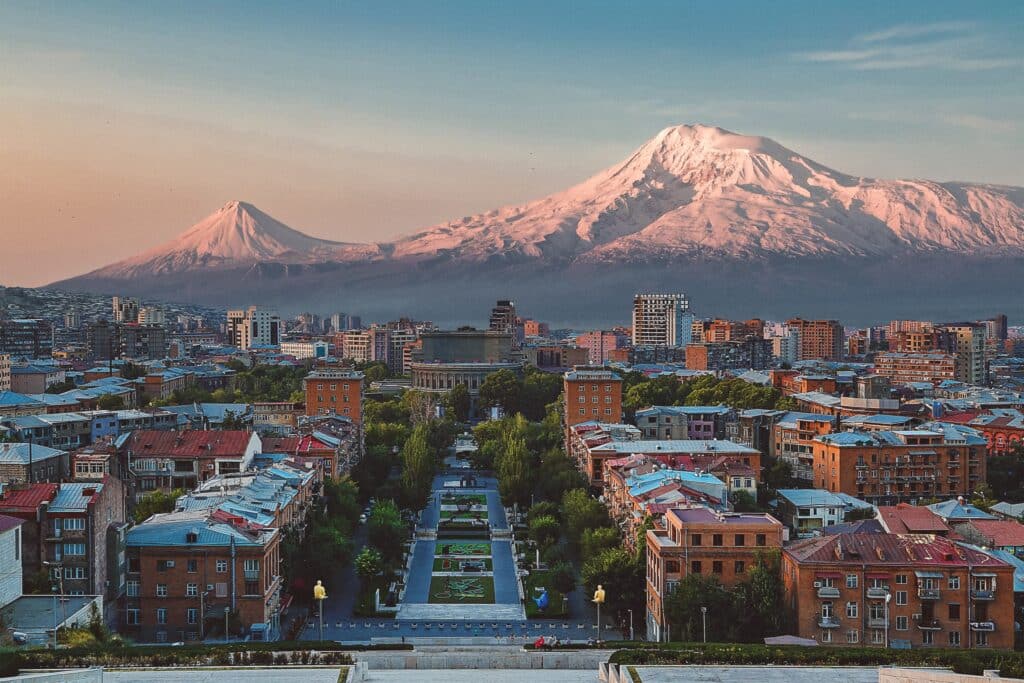
The first time I visited Armenia was exactly 10 years ago, when I took part in an international festival. I was incredibly excited, because it was an unknown and faraway country for me. From the moment I landed in Yerevan I was impressed by the beautiful landscapes around the city, by the imposing Mount Ararat, even by the Soviet-era buildings, which reminded me now of Moscow, now of Sofia. I had the feeling that someone had grabbed me by the hand and carried me 30 years back in time, somewhere to the mid-1980s. The people, meanwhile, were extremely friendly and kind, even though we had a language barrier. It was pure luck to meet someone who spoke English. Today Yerevan has nothing in common with the city I saw back then, and the growth of tourism has helped to smarten up the capital. A modern, wide and lively city centre, renovated massive buildings, well-kept parks and museum complexes, expensive 5-star hotels and much, much more. The city has gone from a small, somewhat neglected capital on the edge of Europe to a progressive modern city, bursting with life, with young people thirsty for culture. An absolute transformation, as if the city had turned from a caterpillar into a beautiful pinkish butterfly. It is no coincidence that it is called “The Pink City”, because of the buildings in the city centre made of dark pink stone.

When to visit Armenia?
The perfect time to visit Armenia is in September and October, or at the beginning of summer, in June, when daytime temperatures are still pleasant and at night they don’t drop below 12-15 degrees. Autumn in Armenia is especially beautiful with its whole palette of colours. The busiest months for tourism are July and August, but temperatures quite often exceed 30 degrees and accommodation prices reach their peak. April and May, on the other hand, are considered rainy months, and although temperatures are pleasant, I wouldn’t advise you to take the risk.
How to get there?
Yerevan has a beautiful, modern international airport. This year one of the low-cost airlines launched direct flights from Sofia to the Armenian capital at very affordable prices, with the flight taking around 3 hours. If there are no flights that suit you, you can travel with a connection through Istanbul, Athens or Cyprus, as the closest and most convenient transfer connections. Although Yerevan has a metro, it doesn’t reach the airport, and from there you can easily get to the centre by marshrutka (minibus) or taxi. Bear in mind that there is no way to get there by car through Turkey, because the land border with their neighbour is closed due to political disagreements between the two countries.
What to see in Yerevan?
Republic Square
Republic Square, or as the locals call it for short – “The Square”, is the heart and social centre of Yerevan. This is where locals usually arrange to meet, and for tourists it is one of the most popular and iconic sights in the Armenian capital. During your stay in Yerevan you will probably pass through Republic Square several times, because all the main streets of the capital run through here. It was built during the communist era and originally bore the name “Lenin”. It was built on the site of the old part of the city, which is why Yerevan today has no clearly defined Old Town. It is surrounded by massive, imposing buildings, also from the communist era, but of great public importance – the National History Museum, the Government House with the clock, the National Gallery, the Central Post Office and others. Here you will certainly get a visual explanation, albeit an indirect one, of why Yerevan is known as “The Pink City”. All the public and residential buildings around the square are built from the pinkish volcanic stone so typical of the city.
Republic Square is even livelier in the evening, when between May and September the sound and light show of the Dancing Fountains takes place here. Locals and tourists gather at 8 pm, when the show begins, to enjoy the music in sync with the colourful jets of water which for two hours “dance” beautifully and tirelessly, twisting in harmonious “movements” and stirring pleasant emotions. An interesting fact is that this was the first fountain of its kind in the former Soviet Union.

The Cascade Complex
The Cascade Complex, or simply “the Cascade”, is another iconic sight in the Armenian capital, once again a masterpiece of the city’s Soviet architecture. The complex has no equivalent in any other capital of the former Soviet Union. It is very hard to describe exactly what the complex is – it is neither a museum nor a building. The idea of the architects who designed and worked on building the Cascade was to connect the northern part of the capital with the centre, not simply by making a staircase, but by creating a modernist and beautiful structure that would complement the contemporary skyline of the city – and they have definitely succeeded. The Cascade Complex is truly imposing and impressive. Besides the 572 steps to the top of the hill, the complex consists of terraced gardens, fountains, exhibition halls, modernist sculptures and a hidden escalator, which can spare you the tiring climb up the stairs. The climb may make you break a sweat, but it is definitely worth the effort. The view that opens up over the city, and in clearer weather towards Mount Ararat, is simply stunning.

Victory Park and the Mother Armenia monument
If you climb up to the hill above the Cascade you will find yourself at the entrance to the largest park in the capital Yerevan – Victory Park, dedicated to the Soviet Union’s victory in the Second World War. It is one of the favourite places for a stroll among Yerevan’s residents, especially pleasant on sunny days. The park offers an incredible view of the city, perhaps one of the best. In the park there are plenty of well-kept paths, a lake, cafés, even a Ferris wheel.
A particularly popular attraction and a source of pride for the people of Yerevan is the monument to “Mother Armenia”, located in the heart of the park, bravely raising a sword, ready to defend the entire Armenian people. The pedestal beneath the monument houses the Military Museum, and opposite the monument itself is the Tomb of the Unknown Soldier, dedicated to those who died during the Second World War. An interesting fact is that on the site of the imposing “Mother Armenia” there originally stood a monument to Stalin, which was removed in the 1960s.

“Matenadaran” – the museum of ancient manuscripts
In Old Armenian “matenadaran” means a book repository, and indeed the “Matenadaran” museum is the largest repository of ancient manuscripts in the world. It is the pride of the Armenian people. The “Mesrop Mashtots” Institute of Ancient Manuscripts, as the museum is officially called, was founded in the middle of the last century and has gathered in one place over 17 thousand manuscripts from all over the world. The “Matenadaran” bears the name of the creator of the Armenian alphabet – Mesrop Mashtots, and his statue stands in front of the museum to welcome those who wish to touch ancient Armenian culture. The main written exhibits with which the institute was originally founded are nationalised manuscripts from the monastery of Etchmiadzin. It is fascinating to see so many manuscripts, kept and preserved for centuries, in one place. The oldest written document dates from the 5th century. The Institute of Ancient Manuscripts is located on the hill above the Cascade, close to Victory Park as well.

The Cathedral of Saint Gregory the Illuminator
The Armenians are proud of another fact – Armenia is the first country in the world to adopt Christianity as its state religion, more than 17 centuries ago. This happened thanks to St Gregory the Illuminator, who in the 4th century baptised the Armenian people and devoted his life to spreading Christianity across their lands.
The cathedral in Yerevan bears the name of Saint Gregory and was built to mark 1,700 years since Christianity was adopted as the state religion in Armenia, and it is the largest church in the South Caucasus, not just in the country. Although for some Armenians the cathedral building itself is ugly because of its blocky architecture, I personally was impressed, because I had never seen an Apostolic church before. It is also one of the main sights of the Armenian capital.

The Blue Mosque
Although 97% of Armenia’s population is Christian, you will probably be surprised to discover that in the centre of the capital there is a mosque, and a working one at that. The Blue Mosque, or “the Heavenly Mosque”, as it used to be called, is the only place of worship for Muslims in Yerevan, attended mainly by the city’s Iranian community. The mosque was built in the 18th century by the Persian ruler Hussein Ali Khan. An interesting fact is that when Armenia was part of the Soviet Union, all the mosques in the capital were destroyed. Only the Blue Mosque miraculously managed to survive, being turned into a museum and later into a planetarium. Today the mosque is fully functioning and you can visit it freely. The architecture is especially impressive thanks to the beautiful coloured mosaics that decorate its façade and dome. The atmosphere will transport you to a calm and secluded place where you can rest from the city noise and enjoy beautiful Islamic art.

Armenian Genocide Memorial Complex – “Tsitsernakaberd”
One of the most tragic and devastating moments in Armenian history is undoubtedly the genocide against the Armenians carried out by the Ottoman Empire at the beginning of the last century. An event that marked the country’s development for generations to come. Between 1915 and 1918, over one and a half million Armenians were killed, and tens of thousands were forcibly deported from their homelands, with the aim of suppressing the Armenian national movements in the empire.
The memorial complex was erected in 1967 on one of the hills around Yerevan – Tsitsernakaberd. It includes a monument to the victims of the Armenian Genocide, a museum section and a mausoleum with 12 massive pylons, in the middle of which burns the eternal flame, where locals and tourists pay their respects to the victims.

Vernissage
In the centre of Yerevan, close to Republic Square, you will find the colourful flea market of the capital, called “Vernissage”. There you can discover all sorts of antiques, souvenirs, jewellery, hand-woven Armenian carpets, wood-carved objects, old gramophone records, paintings, Soviet coins and relics, and who knows what else. Pay particular attention to the carpets, as they are part of Armenian culture. There are plenty of cafés and pleasant places in the area where you can also try the local cuisine.

Katoghike Church
The Armenians are a people truly devoted to their faith. In the capital Yerevan you can see dozens of churches, some large and remarkable, others considerably smaller, nestled between the Soviet-era residential blocks. One of the most distinctive, however, considered the oldest in the city, is Katoghike Church, dedicated to the Holy Mother of God. The religious complex consists of two churches – a small chapel from the middle of the 13th century and a larger basilica, which in its time was one of the largest in Yerevan. More impressive is the small chapel, where you can see preserved medieval frescoes. Fortunately, Katoghike has managed to withstand time, despite the hardships the city has endured – from earthquakes to Soviet urban planning, when many historically important buildings were wiped off the map.

Moscow Cinema
Moscow Cinema is one of the sights that is, once again, an example of early Soviet architecture in Yerevan. Almost a century after its opening, the cinema still fulfils its function, and it also hosts the “Golden Apricot” International Film Festival. On the façade of the building there are Soviet-style bas-reliefs of scenes from various Russian and Armenian films.

The old Kond neighbourhood
You will probably spend most of your time in the city centre when visiting Yerevan, but for those of you who would like to get to know the Armenian capital even better, I highly recommend going to one of Yerevan’s oldest neighbourhoods – Kond. I have already mentioned that when the modern part of the city centre was built, Yerevan’s Old Town was wiped out so that all those large, representative Soviet buildings could be erected under communism. Kond, however, managed to survive, and today the area attracts tourists who want to get a feel for the city as it was before Armenia became part of the Soviet Union. It is certainly not the most glamorous or representative part of the capital, but the neighbourhood has its own charm with its narrow little streets, colourful houses and graffiti-covered walls. It is the perfect place for an aimless stroll.

Brandy tasting at the “Ararat” factory
Visiting Yerevan without trying the famous local brandy is like going to a birthday party and not eating any cake. The history of the “Ararat” brandy factory dates back to the 16th century, when the Persians built a defensive fortress on its present-day site. In a strong earthquake almost 300 years later, the fortress was destroyed and the local merchant Nerses Tairyan bought the ruins to build a wine cellar here. Later, together with his brother, he began producing brandy using the French method, and the drink became extremely popular among Armenians, and later they also began exporting it on a large scale. One of the most ardent admirers of Armenian brandy was the writer Maxim Gorky, who said that “it is probably easier to climb Mount Ararat than to get out of the cellars of the factory of the fiery drink ‘Ararat’”. Today the factory building has a museum section, where you can see how brandy production has evolved over the years, as well as taste the different kinds of spirits produced at “Ararat”.

The Temple of Garni
The pagan temple in the village of Garni is less than 30 km from Yerevan and is one of the most interesting places around the Armenian capital. It is dedicated to the god Mithra, god of the Sun, of heavenly light and of justice, son of the Great Mother Goddess, the Earth. The temple is the only one to have survived after the adoption of Christianity in Armenia in 301, and the only fully preserved monument from the Greco-Roman period in the former Soviet Union. In pagan times, the locals held the festival celebrating the birth of Mithra here – Mehekan (on 25 December). When the Arabs conquered the Armenian lands, the temple was turned into a mosque, which was destroyed in a powerful earthquake in the 17th century. Almost two centuries later its complete reconstruction began and it was restored to its original appearance. The Temple of Mithra is a must-see if you have more time during your visit to Yerevan.
You can sign up for an organised day trip from Yerevan to the Temple of Garni and Geghard Monastery HERE.

Geghard Monastery
Just about 15 minutes by car from Garni lies the medieval monastery of Geghard, another must-see sight in the surroundings of the capital Yerevan. The monastery was founded by Saint Gregory the Illuminator and is an extremely important and revered place for Armenians. Originally the monastery was carved into the rocks, but later the monastery complex grew and more rock-cut churches, monks’ dwellings and rock tombs of monks and noble Armenian families were created. Over the years the monastery suffered numerous lootings and destruction, until it was restored in the 13th century. It was then that the large cathedral of the monastery was built, and the complex gained enormous significance for the development of Armenian writing and culture. According to one of the legends, an exceptionally great holy relic was kept here – the Holy Lance, with which Jesus was pierced on the cross. Today it is kept in the “religious capital” of Armenia – Etchmiadzin.

Etchmiadzin and Zvartnots
Etchmiadzin is to Armenia what the Vatican is to the Catholic world. It is the most sacred place for the Armenian people. The small town lies about 30 kilometres from Yerevan and you can easily get there by taxi or marshrutka. The cathedral in Etchmiadzin is the most popular sight in the little town. It is considered the oldest Christian church in the country and one of the oldest in the world. Built at the beginning of the 4th century and remodelled several times, today it holds some of the most precious religious relics, among them a fragment of the relics of St John the Baptist, the relics of St Gregory the Illuminator, as well as the tip of the lance with which Christ was pierced after his crucifixion. Another very major sight in the area, just 5 km from Etchmiadzin, are the remains of Zvartnots Cathedral, destroyed in a strong earthquake in the 10th century. Today only some of its arches and columns remain, to remind us of its former grandeur.
You can sign up for an organised day trip from Yerevan to Etchmiadzin and Zvartnots Cathedral HERE.

Author
Vilislav Alkantara