
Munich has that rare talent of greeting you in a way that is at once orderly and warm, elegant and lively, with the feeling that every street keeps its own story. This is a city where classical architecture, old squares, green parks and Bavarian tradition are not a backdrop but a natural part of everyday life. From your very first steps around the centre you sense a calm confidence — Munich doesn’t try to impress loudly, because it knows its beauty reveals itself gradually: in the details on the façades, in the arches of the old buildings, in the aromas around the markets, in the sound of the bells and in the light that falls on the rooftops of the old town.
It is a place that manages to combine different worlds with surprising ease. In the morning you can start the day among the exquisite buildings around Marienplatz, get lost in the narrow lanes of the old town, stop for coffee on a bustling square, and in the afternoon find yourself amid the greenery of the Englischer Garten, where locals read, cycle, stroll or simply enjoy the rhythm of the city. Munich carries a sense of quality — in the food, in the space, in the architecture, in the way people live. Everything here seems well thought out, yet without losing its soul.
The best thing about Munich is that it reveals itself not only through its sights, but through the atmosphere between them. Between the majestic squares and the quiet side streets, between the museums and the beer gardens, between the old churches and the modern neighbourhoods, there is a particular gentleness that makes the city feel far closer than you expect. It is a destination that can be cultural, romantic, gourmet, artistic, green and surprisingly peaceful — depending on how you choose to experience it.
Munich is a city for travelling without hurrying. A city where it is worth sitting outdoors, watching people, trying something traditional, stepping into a palace, strolling along the River Isar and letting the day lead you on its own. Its charm lies precisely in this natural harmony between history, culture, nature and city life — subtle, steady and memorable. And when you leave, Munich stays in your mind not as a list of places, but as a feeling of orderly beauty, good taste and that particular calm that only some cities know how to leave behind.
In this article I have gathered the top 20 most interesting sights in the Bavarian capital Munich, as well as some tips that will make your stay there even more exciting and interesting.

How to get to Munich?
Getting to Munich is easy and convenient, especially if you are travelling from Sofia. There are direct flights from Sofia to Munich, and the flight is short enough to make the city a great idea both for a long weekend and for a fuller trip of several days. It is one of those routes where you can be in Bulgaria in the morning and by the afternoon already be walking the streets around Marienplatz with a coffee in hand and your first impression of the Bavarian capital.
Munich Airport — Flughafen München — is located about 28–30 km north-east of the centre. The most convenient way to get to the city is by S-Bahn lines S1 or S8. Both connect the airport with key central points such as Hauptbahnhof, Marienplatz and Ostbahnhof. The journey takes approximately 40–45 minutes, and the trains run regularly, which makes getting around relatively easy even if you are arriving for the first time.
A very practical option is the Airport-City-Day-Ticket, especially if you plan to use public transport on the day you arrive. This ticket covers the journey from the airport to the city and lets you travel within zones M–5 throughout the day. The price is about €17.50 for a single ticket and about €32.60 for a group ticket. If two or more of you are travelling together, the group ticket often works out cheaper and is a convenient choice.
Another option is the Lufthansa Express Bus, which connects the airport with central Munich. It is a good choice if you have more luggage or prefer a direct bus transfer. A taxi or private transfer to the centre is also possible, but usually considerably more expensive. Unless you are arriving very late at night, the S-Bahn remains the most practical and economical way to find yourself in the heart of the city.
When to visit Munich?
Munich has a different face in every season, and that is exactly what makes it worth more than one visit. Spring is mild, fresh and very pleasant for walks. From April to June the city starts to move outdoors — the parks fill up, the cafés come to life, and the beer gardens gradually become one of the loveliest scenes of local life. It is a great time if you want to explore at a relaxed pace, without the big summer crowds.
Summer in Munich is green, social and very lively. The days are long, the English Garden is full of people, the River Isar becomes a favourite spot for walks and relaxation, and the city looks like a neat, sunny version of itself. July and August can be busier, especially around the popular museums and central sights, but if you love cities with outdoor life, this is a wonderful time.
September and early October bring Munich’s most iconic event — Oktoberfest. In 2026 the festival will take place from 19 September to 4 October on the Theresienwiese festival grounds. This is a period when the city changes its rhythm — it becomes louder, more colourful, more festive. Hotels, however, become much more expensive, so if you are planning a trip exactly then, book as early as possible.
Winter in Munich has a completely different magic. The Christmas markets, the lights around Marienplatz, the scent of mulled wine, roasted nuts and sweets turn the centre into a warm stage amid the cold air. December is a beautiful month to visit, especially if you love a festive atmosphere, old towns and cosier winter trips.
Where to stay in Munich?
If you are visiting Munich for the first time, it is most convenient to stay in Altstadt-Lehel — the old part of the city. This is the area where almost everything is within walking distance: Marienplatz, the Frauenkirche, the Viktualienmarkt, the Hofbräuhaus, the Munich Residenz and most of the main sights. Staying here means stepping out of your hotel and immediately finding yourself in the atmosphere of the city.
Maxvorstadt is a great choice if you love museums, galleries, bookshops, cafés and a more intellectual urban setting. This is where you will find the Pinakotheken, the university district and many pleasant places for coffee or dinner. The area is a little calmer than the centre itself, yet close enough to everything important.
Ludwigsvorstadt-Isarvorstadt is a practical area, especially if you want to be near the central station or are travelling during Oktoberfest. This is where the Theresienwiese festival grounds are located, and public transport connections are very convenient. The area is more dynamic and diverse, with more bustle, restaurants and nightlife.
Haidhausen is one of the most pleasant neighbourhoods for people who want a more local feel. Beautiful streets, cosy cafés, good restaurants and a relaxed atmosphere — it is a great choice if you no longer insist on being literally in the heart of the old town. Schwabing, on the other hand, suits a more artistic mood, closeness to the English Garden and more bars, restaurants and urban energy.
How to get around the city?
Munich has very well-organised public transport, which includes the U-Bahn, S-Bahn, trams and buses. For tourists the U-Bahn and S-Bahn are the most convenient, because they connect the main districts, the airport, the central station and the major sights. The system seems a bit complicated at first because of the zones, but after your first journey it becomes quite intuitive.
For exploring the central area, zone M will usually be enough. If you are travelling to or from the airport, you need a ticket for zones M–5. The day ticket is very handy if you plan to get around the city a lot, because it allows unlimited journeys in the selected zones until 6:00 a.m. the following day.
Munich, however, is also a city that is wonderful to experience on foot. In the old town the distances are pleasant, the streets are beautiful, and you can easily move between Marienplatz, the Viktualienmarkt, the Munich Residenz, the Frauenkirche and the Hofbräuhaus without any transport. If the weather is good, a bicycle is also a great option, especially for the English Garden, the Olympic Park and the areas along the River Isar.
Which local dishes to try?
Munich is a city where food is part of the culture, not just a pause between two sights. Start with Weißwurst — traditional white Bavarian sausages, usually served with mild sweet mustard and a pretzel. It is a classic, especially for a late breakfast or early lunch, and one of those things you have to try at least once.
Schweinshaxe is another Bavarian icon — roast pork knuckle with crispy crackling, often served with potato dumplings and gravy. It is a heavy, rich and very characteristic dish that goes best in a traditional beer hall or a restaurant serving local cuisine. If you want to try something typically Munich, this is a safe bet.
Leberkäse is a more unpretentious but very popular local speciality — something like a baked meatloaf, often served in a bread roll with mustard. Obazda is a creamy spread of cheese, butter, spices and onion, eaten with a pretzel and ideal for sharing. Käsespätzle is a great choice if you want something comforting and meat-free — a rich combination of little egg noodles, cheese and fried onions.
For dessert, look for Apfelstrudel or Kaiserschmarrn. Apfelstrudel is a classic with apples, cinnamon and thin pastry, while Kaiserschmarrn is a fluffy shredded pancake dessert, often served with icing sugar and fruit compote. And if you want to feel the city through its flavours, set aside time for the Viktualienmarkt — that is where Munich is at its most appetising, most colourful and most alive.
What to see in Munich?
Marienplatz
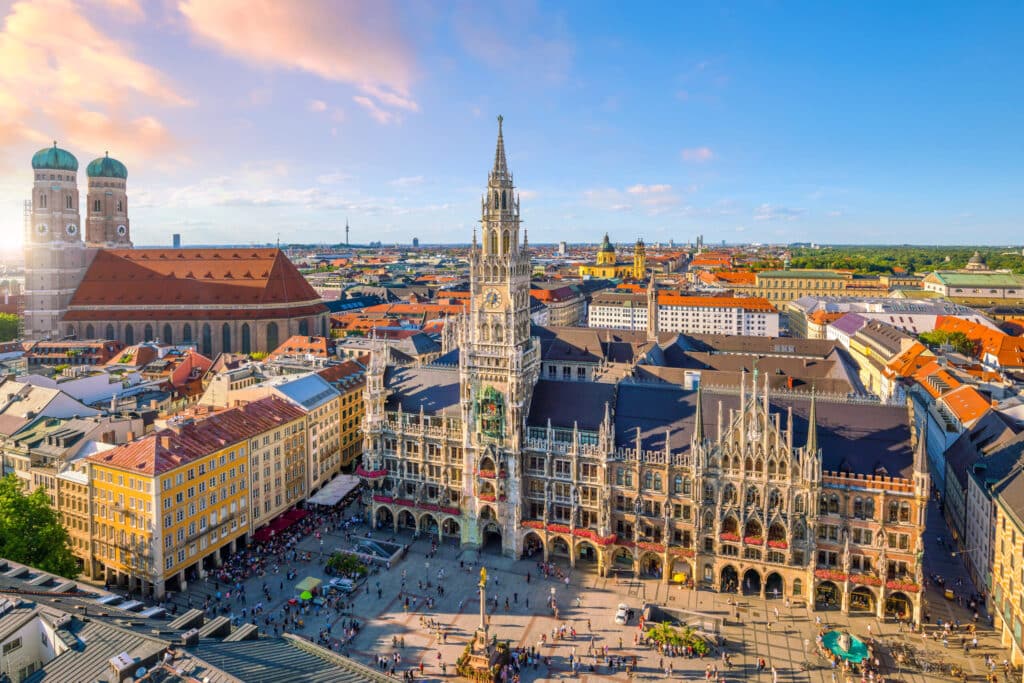
Marienplatz is the place where Munich seems to start talking to you. It is the centre, the stage, the heart of the old town — a square crossed by tourists, locals, street musicians, guided groups, people with coffee, people with cameras and people who are simply hurrying somewhere. Yet even amid all the movement there is a sense of order and rhythm. The square is not just a point on the map, but a place that gathers the different faces of the city into a single frame.
Here your gaze almost inevitably settles on the New Town Hall, but Marienplatz has more layers. For centuries it has been a place for markets, events, celebrations and city life. Today it is the ideal first stop, because many of the important sights are concentrated around it. You can come early in the morning, when the square is still waking up, or at midday, when the Glockenspiel draws crowds of people, all looking up at the façade of the town hall.
The most popular moment on Marienplatz is precisely the Glockenspiel — the mechanical clock of the New Town Hall. Its figures come to life every day at 11:00 and 12:00, and from March to October there is an additional show at 17:00. It is one of those tourist moments that may seem a little naïve, but in person it has charm — especially when you see the whole square stop for a few minutes with everyone looking in the same direction.
Entrance fee: free.
Useful tip: Come 10–15 minutes before the Glockenspiel to find a good spot for photos. If you want a calmer feel of the square, come back early in the morning, when Marienplatz is much more beautiful and quiet.

New Town Hall (Neues Rathaus)
The New Town Hall is the building that gives Marienplatz its fairytale, almost theatrical silhouette. Built in the neo-Gothic style between 1867 and 1909, it looks like something much older, much more medieval and much more fantastical than it really is. The façade is full of towers, arches, sculptures, ornaments and small details that you can easily miss if you just pass by in a hurry.
Despite its imposing appearance, the New Town Hall is a working administrative building. This gives it a special charm — it is not a frozen monument, but part of the living city. The local government works behind these richly decorated façades, while outside tourists take photos, wait for the Glockenspiel or simply try to take in the scale of the building.
One of the best opportunities here is the tower of the New Town Hall. It is reached by lift, which makes it more accessible than other viewpoints in the city. From the top there is a wonderful view of the Frauenkirche, St Peter’s Church, the Old Town Hall, the rooftops of the old town and, on a clear day, the Alps. It is a great way to see Munich from above right at the start of your trip.
Entrance fee: viewing from outside is free; the tower costs about €7.
Useful tip: If you want a panoramic view without a serious climb, choose the New Town Hall tower. The view is very beautiful and access is easier compared with the tower of St Peter’s Church.

Old Town Hall (Altes Rathaus)
The Old Town Hall stands on the eastern side of Marienplatz and has a quieter, more restrained presence than the New Town Hall. It is easy for your eye to be stolen by the huge neo-Gothic façade opposite, but if you turn towards the Old Town Hall, you will see an older and more delicate side of Munich. The building has carried the city’s memory for centuries and reminds you that Marienplatz was the centre of city life long before today’s tourist bustle.
The building’s first mention in the city archives dates from 1310, and after being destroyed by lightning in 1460 it was rebuilt by Jörg von Halsbach — the master builder also associated with the Frauenkirche. This gives the Old Town Hall special historical value. It is like a quieter witness to all the changes Munich has gone through — from a medieval town to a modern European capital of culture, business and tradition.
Today the Old Town Hall impresses with its Gothic lines, its tall tower and its cleaner look. It stands as a beautiful counterpoint to the New Town Hall and gives the square a balance between different eras. If you love architecture, give it a few minutes rather than just walking past. Sometimes it is exactly these quieter buildings that tell a city’s story best.
Entrance fee: free to view from outside.
Useful tip: It is best to photograph the Old Town Hall in the morning, when the square is calmer. Look at it both from the Marienplatz side and from the lanes behind it, because the feeling is different.

Munich Residenz (Residenz München)
The Munich Residenz is a place that draws you into a different scale. From the outside it may look like a large, serious palace complex, but the real feeling comes when you step inside. This is the former residence of the Bavarian rulers of the Wittelsbach dynasty and one of the most significant palace complexes in Germany. Here power, art, taste and ambition have left their mark in every hall.
The complex is huge and includes palaces, courtyards, galleries, a treasury, a theatre and richly decorated rooms. This is not a place for a quick stop. The Munich Residenz demands time, because each hall carries a different atmosphere — from lavish ceremony to more intimate palace spaces. Here you realise how powerful and wealthy the Bavarian state was and how important a role culture played in the way it presented itself.
One of the most impressive parts is the Antiquarium — a long Renaissance hall that literally makes you slow your step. The ceilings, the frescoes, the symmetry and the scale create a sense of solemnity. The Treasury, meanwhile, shows another side of power — crowns, relics, jewels and objects created to impress, to legitimise and to endure over time.
Entrance fee: Residence Museum — €10; Treasury — €10; combined ticket Residence Museum + Treasury — €15; Cuvilliés Theatre — €5.
Useful tip: Allow at least 2–3 hours. If you have more time, get a combined ticket for the museum and the treasury, because that way you will get a much fuller sense of the complex’s riches.

Nymphenburg Palace (Schloss Nymphenburg)
Nymphenburg Palace is one of the most beautiful encounters with palatial Munich. It lies a little outside the centre, and as soon as you approach it the feeling changes. The space becomes wider, the air seems to open up, and the palace façade unfolds elegantly in front of the canals and gardens. It is a place with a different rhythm — slower, more aristocratic, more contemplative.
The palace was the summer residence of the Bavarian rulers and is associated with luxury, grandeur and the pleasure of life away from the strict palace centre. The interiors are beautiful, but the real magic comes from the experience as a whole — the façade, the water, the symmetry, the park, the pavilions and the sense of moving between architecture and nature. You can spend much more time here than you originally planned.
The complex includes the palace itself, the Marstallmuseum with royal carriages and sleighs, the Porcelain Museum and park pavilions that open seasonally. The park is a huge part of Nymphenburg’s charm. If the weather is good, a walk outside is almost as important as visiting the interiors. It is one of the places in Munich where the city feels at its calmest and most elegant.
Entrance fee: combined “Nymphenburg” ticket — €20 from 1 April to 15 October and €16 from 16 October to 31 March.
Useful tip: Visit the palace on a day with good weather, because the park is an essential part of the experience. If you can, set aside half a day and don’t combine it with too many other places.

Frauenkirche (Cathedral of Our Dear Lady)
The Frauenkirche is one of the symbols by which Munich can be recognised from afar. Its two tall towers with their distinctive domes dominate the skyline of the old town and create the image that so often appears on postcards, photos and guidebooks. But in person the cathedral has a more special effect — it is imposing without being overloaded, solid without looking heavy.
Its interior is more restrained than other Baroque churches in southern Germany, but that is exactly what gives it strength. The space is high, wide and calm. There is something very Munich about this combination of scale and moderation. The cathedral doesn’t try to dazzle you with decoration, but makes you feel height, silence and time.
One of the best-known legends connected with the Frauenkirche is the “Devil’s Footstep” — Teufelstritt — an imprint in the floor surrounded by various stories. You can also visit the south tower, which offers a panoramic view of Munich. On a clear day the horizon opens up towards the Alps, turning the visit into much more than a standard stop in the centre.
Entrance fee: the cathedral is free; the south tower — €7.50 for adults.
Useful tip: Go inside even if you don’t have much time. The Frauenkirche is one of the places that give you a sense of Munich’s historical weight.

St Peter’s Church (Peterskirche)
St Peter’s Church, also known as Alter Peter, is the oldest parish church in Munich and one of the best viewpoints in the city. It stands very close to Marienplatz, but has a different atmosphere — more intimate, older and a little hidden behind the bustle of the centre. If you love places that combine history and a view, this is one of the must-see stops.
The interior is beautiful and deserves attention, but the tower is the big reason many people come here. The climb is serious — over 300 steps, narrow passages and moments when you will feel that this is not the easiest part of the day. But when you reach the top, Munich spreads out before you in one of its most classic views: the New Town Hall, Marienplatz, the rooftops of the old town and the towers of the Frauenkirche.
It is a view that is worth the effort. From above, Munich looks both orderly and alive — with red roofs, bell towers, squares and modern lines in the distance. If the weather is clear, you may also see the Alps. It is precisely from this height that the city starts to arrange itself in your mind not just as a route, but as a picture.
Entrance fee: the church is free; the tower — €5 for adults, €3 reduced ticket, €2 for pupils aged 6–18.
Useful tip: Climb in the morning or around sunset, when the light is at its most beautiful. Don’t do it with heavy luggage, because the stairs are narrow and the climb is more tiring than it looks.

Asam Church (Asamkirche)
The Asamkirche is small, narrow and almost unnoticeable from the outside if you are walking quickly along Sendlinger Straße. But as soon as you step inside, the space explodes with Baroque energy — gold, light, movement, sculptures, frescoes and dramatic details packed into a surprisingly small volume. It is one of those places that prove grandeur isn’t always a question of size.
Built in the 18th century by the Asam brothers, the church is a personal project created with enormous artistic imagination. Every centimetre inside seems carefully thought out. Your gaze is constantly moving — up to the ceiling, to the altar, to the ornaments, to the sculptures, to the light. There is no empty space in the Asamkirche. Everything speaks, everything curves, everything contributes to the overall feeling.
It is a place for a short but very powerful visit. You don’t need hours to feel it. Fifteen to twenty minutes are enough — but minutes in which you really look. Among all of Munich’s great squares, palaces and museums, the Asamkirche is like a hidden jewellery box — small, concentrated and exceptionally memorable.
Entrance fee: free, donations welcome.
Useful tip: Go in even if your schedule is busy. The church is in the centre and the visit doesn’t take long, but it leaves a strong impression.

Alte Pinakothek
The Alte Pinakothek is one of those museums where time starts to move more slowly. It is one of the most important art museums in Europe and brings together works from the Middle Ages to the 18th century. If you love classical art, this place may become one of the highlights of your trip.
The collection includes big names of European painting and lets you trace the development of art over the centuries. There are paintings here that you don’t just stop in front of — you stay. You look at the details, the faces, the light, the gestures, the colours, and begin to feel how much history a single image can hold.
The building is spacious and designed to give the art room to breathe. This is not a museum to “tick off”. It is better to choose a few rooms and explore them calmly than to try to see everything at once. The Alte Pinakothek is especially suited to a slower day in Munich — a day when the city moves from the streets to the quiet of the galleries.
Entrance fee: €9 for the permanent collection; €6 reduced ticket; €1 on Sundays.
Useful tip: Sunday is a great-value day to visit thanks to the €1 ticket, but it can be busier. If you want a calmer experience, choose a weekday.

Neue Pinakothek
The Neue Pinakothek is an important part of Munich’s museum quarter and is usually devoted to 19th-century art — a period of Romanticism, Realism, Impressionism and early modern movements. It is the bridge between the old masters and modern art, between classical painting and those freer, more emotional explorations that changed Europe’s visual culture.
As of July 2026, the Neue Pinakothek building is closed for major renovation, with reopening planned for 2029. This is important to know so that you don’t plan it as a stand-alone visit. The good news is that some of the important works from the collection can be seen in the Alte Pinakothek and the Sammlung Schack.
Even while closed, the Neue Pinakothek remains part of the city’s cultural map, because it shows how strongly Munich thinks of art not as separate museums but as a whole quarter of visual memory. If you love painting, you can feel its presence through the temporary relocation of the collection and leave yourself a reason to come back after it reopens.
Entrance fee: the Neue Pinakothek itself is closed; selected works can be seen in the Alte Pinakothek with its ticket.
Useful tip: Don’t plan a separate visit to the building as a working museum. Instead, combine the Alte Pinakothek and the Pinakothek der Moderne.

Pinakothek der Moderne
The Pinakothek der Moderne shows a completely different face of Munich — bolder, cleaner, more contemporary. It is one of the most interesting museums in the city, because it isn’t limited to painting. Modern and contemporary art, design, architecture and graphic art meet under one roof. The space is large, bright and open, and the building itself already creates a sense of modernity.
Here you can see how art begins to converse with objects, with space, with ideas and with everyday life. One room might introduce you to painting, another to design, a third to architectural models or graphic experiments. This makes the museum very lively and varied, especially if you love places that don’t offer just one point of view.
The Pinakothek der Moderne is a great stop if you want to balance the palaces and old churches with something more contemporary. Munich is often seen through its traditions, but this museum reminds you that the city also has a strong modern cultural energy. It is a place that inspires not only through the works themselves, but through the way it arranges them in dialogue.
Entrance fee: €10; €7 reduced ticket; €1 on Sundays. Combined ticket for several museums — €12, excluding paid special exhibitions.
Useful tip: If you only have one day for museums, combine the Pinakothek der Moderne with the Alte Pinakothek. That way you will see two completely different worlds of art.

BMW Museum
The BMW Museum is one of those places in Munich where design, technology and a brand’s identity turn into an experience. Even if you are not a keen car fan, the museum can be interesting, because it tells a story not only of cars, but of engineering thinking, aesthetics, speed, ambition and German precision.
The building itself is impressive, and the exhibition traces BMW’s development through cars, motorcycles, concept models and technological solutions. Here you can see how a brand builds its image over the decades — through shapes, lines, engines, advertising, sport and innovation. The museum is very visual and also suits people who love photography, design or modern architecture.
Next to the museum is BMW Welt — a freely accessible space where you can look at current models and get a feel for the more contemporary side of the brand. The combination of the BMW Museum, BMW Welt and the Olympic Park makes this area very convenient for half a day away from the old centre.
Entrance fee: €17 standard ticket; €9 reduced; BMW Welt is free to enter.
Useful tip: Combine the BMW Museum with the Olympic Park and the Sea Life München aquarium. The area is easy to explore in one day.

Deutsches Museum
The Deutsches Museum is huge, fascinating and far more exciting than it may sound at first. It is one of the largest museums of science and technology in the world and a place where you can spend hours without noticing time passing. It stands on Museumsinsel, and its location alone makes it a pleasant part of a walk around the city.
The exhibitions cover aviation, energy, physics, astronomy, transport, musical instruments, communications and many more subjects. It is a museum that awakens childlike curiosity even in adults. There is something very enjoyable about entering a space that doesn’t just display objects but explains how the world works — how we fly, how we measure, how we create, how we think technologically.
The Deutsches Museum is particularly suitable for families, but not only. If you love interactive exhibitions, technology, science stories or simply places that go beyond the classic museum format, this is one of the strongest stops in Munich. The only risk is underestimating its size — you can easily stay here much longer than you planned.
Entrance fee: €16 for adults; €9 reduced; €33 family ticket.
Useful tip: Choose in advance the sections that interest you most. The museum is enormous and it is better to explore it by theme rather than trying to see everything.

English Garden (Englischer Garten)
The English Garden is the place where Munich takes off its formal jacket and simply starts to breathe. It is one of the largest urban parks in the world and one of the loveliest spaces in the city. Here locals read, exercise, cycle, lie on the grass, meet friends or simply spend the afternoon without any particular plan.
The park is huge, stretching for about 5.5 km and linking the natural areas along the Isar with the old part of the city. The best thing is that the English Garden doesn’t feel like an “attraction”, but like part of everyday life in Munich. It is a place you don’t visit just for a photo, but to stay. To sit on the grass. To walk with no direction. To watch people. To feel how much greenery there is in this otherwise so orderly city.
Among the most interesting places in the park are the Monopteros, the Chinesischer Turm, the Kleinhesseloher See and the Eisbachwelle — the urban river wave where surfers ride in the middle of the city. This scene is so unexpected that it almost always draws an audience. You stand on the bridge, watching the water, the surfers, the crowd, and for a moment Munich seems much freer and more surprising than you imagined.
Entrance fee: free.
Useful tip: Start at the Eisbachwelle near the Haus der Kunst, then continue to the Monopteros and the Chinesischer Turm. If the weather is good, allow more time and don’t rush.

Olympic Park (Olympiapark)
The Olympic Park is one of the most interesting spaces in Munich, because it carries the spirit of the 1970s, sporting history and modern architecture in a very beautiful balance. Created for the 1972 Summer Olympic Games, the park still looks impressive today with its hills, lake, wide paths and the iconic roof structures of the Olympic venues.
It is a place with different faces. You can come for a walk, for photos, for a concert, for a sporting event or simply to see a different part of Munich. The architecture is futuristic, but the greenery softens it. The result is a space that resembles neither a classic park nor a standard sports zone. It has character, history and plenty of air.
The Olympic Tower has been temporarily closed for renovation since 1 June 2024, with reopening expected in the fourth quarter of 2027. Even so, the park is well worth a visit, especially if you combine it with the BMW Museum or the Sea Life München aquarium. And if you climb the Olympiaberg, you will get one of the best views of the area.
Entrance fee: entry to the park is free; individual tours and attractions are paid. The Olympic Tower is closed for renovation.
Useful tip: Go in the early evening, when the light is at its most beautiful. The Olympiaberg is a great spot for photos and a view of the park.

Hofbräuhaus (Hofbräuhaus am Platzl)
The Hofbräuhaus is a place that needs to be experienced with the right mindset. It is noisy, lively, touristy, packed with people and very Bavarian. But that is exactly part of its charm. It is not just a restaurant, but a stage — with long wooden tables, beer steins, traditional music, waiters in Bavarian costume, groups of tourists and locals who look as if they have been coming here for years.
The history of the Hofbräuhaus is long and closely tied to Munich’s beer culture. Today the place is one of the most popular stops in the city, but despite its touristy character it still carries a sense of tradition. If you sit at a shared table, order something typical and let the noise around you become part of the experience, you will understand why this place is so famous.
The menu features classic Bavarian dishes — sausages, pork knuckle, pretzels, Obazda, Leberkäse and other hearty, comforting flavours. It is a good place to try traditional food, especially if you want dinner with atmosphere rather than just a quiet restaurant. The Hofbräuhaus is Munich in its louder, festive and slightly theatrical form.
Entrance fee: free; you pay for what you order.
Useful tip: For a calmer experience, go earlier in the day. In the evening the atmosphere is at its liveliest, but also at its busiest.

Viktualienmarkt
The Viktualienmarkt is one of the tastiest places in Munich. It is very close to Marienplatz, but has a completely different energy — more colourful, more fragrant, more everyday. It is a place where you can experience the city through its food: fruit, vegetables, cheeses, sausages, bread, flowers, spices, delicacies and ready-made dishes.
The market is great for lunch without a strict plan. You can grab something on the go, try local produce, sit in the beer garden or simply wander between the stalls. Here Munich seems less formal and much more approachable. People shop, chat, have a bite, carry flowers, choose cheese or simply stop for something small and delicious.
The Viktualienmarkt is especially pleasant before lunch, when the stalls are at their liveliest. It is also a great place for photos, because the colours, the produce and the movement create a very natural urban scene. If you love markets, don’t miss it. Here you can learn a lot about a city without setting foot in a museum.
Entrance fee: free; you pay for what you consume.
Useful tip: Visit the market before lunch and don’t come on a Sunday, because markets in Germany usually aren’t really open then.

Theresienwiese festival grounds (Theresienwiese)
The Theresienwiese is the large open space that for most of the year can look calm and almost empty. But when Oktoberfest arrives, this place turns into a completely different world — a temporary city of tents, music, rides, traditional costumes, beer, food and millions of visitors. It is one of the most recognisable scenes of Bavarian culture.
Oktoberfest 2026 will take place from 19 September to 4 October. If you happen to be in Munich at that time, you will feel the whole city change its pace. People in traditional dress appear on the streets, the hotels fill up, the restaurants become livelier, and the Theresienwiese becomes the centre of events.
Even if you are not a big beer fan, Oktoberfest is a cultural experience. There is music, food, rides, family areas, the historic Oide Wiesn section and plenty of opportunities simply to watch. It is important, however, to plan carefully, because this is the busiest period in Munich and accommodation prices can be much higher.
Entrance fee: free for the Theresienwiese festival grounds and the main tents during Oktoberfest; Oide Wiesn — €4.
Useful tip: If you want a calmer experience, visit Oktoberfest on a weekday and earlier in the day. For evenings and weekends it is best to have a tent reservation.

Allianz Arena
The Allianz Arena is a must-see stop for football fans, but it can also impress people who simply love modern architecture. The home of FC Bayern München is one of the most recognisable arenas in Europe, with its façade that can light up in different colours. Even from the outside the stadium looks different — like a huge, softly lit object that changes its character depending on the event.
If you love football, a visit here has a completely different emotion. Bayern München is not just a club, but part of the city’s identity. The stadium tour lets you see places that usually stay hidden — stands, interior spaces, areas connected with match day. The FC Bayern Museum adds historical context with trophies, photos, stories and moments from the club’s development.
Even without a match, the Allianz Arena has a powerful presence. It is best if you manage to see it both from outside and on a tour. And if there is a match during your stay, the atmosphere is completely different — the U-Bahn to Fröttmanning fills with fans, and the whole area starts to live to the rhythm of football.
Entrance fee: €25 for the FC Bayern Museum + Arena Tour; €12 for the FC Bayern Museum only.
Useful tip: Check in advance whether there is a match or event, because tours may be limited. The stadium is easy to reach by U-Bahn to Fröttmanning.

Sea Life München aquarium (Sea Life München)
The Sea Life München aquarium is a lighter and pleasant stop, especially if you are travelling with children or if the weather outside isn’t suitable for walks. It is located in the Olympic Park area and showcases various sea and freshwater creatures, themed zones and educational elements. It is not the biggest sight in Munich, but it is a good option for variety.
The visit is especially convenient if you have already planned the BMW Museum or the Olympic Park. That way you can make a whole route in this part of the city — first automotive history and design, then a walk in the park, and after that the aquarium. Sea Life München is a calmer experience and can be a good break between the larger museums and the big urban spaces.
Inside you will see various aquatic creatures and themed tanks, which are most interesting for families. For adults the visit may be relatively short, but enjoyable. If you love the marine world, aquariums, or are simply looking for something different from palaces, churches and museums, this place can fit nicely into your schedule.
Entrance fee: online from €20 per adult; on the door about €25 per adult.
Useful tip: Buy your ticket online in advance, because it is usually cheaper and comes with a time slot. It is most practical to combine it with the Olympic Park and the BMW Museum.


Author
Vilislav Alkantara