
Very recently one of Disney‘s hit films premiered – The Lion King. A remake of one of my favourite cartoons from childhood, which became a legend with its epic characters 25 years ago. Leaving aside the incredible story told by the ’94 classic, something else impressed me – the incredible African landscapes shown in the new version of my favourite film, and all those majestic animals we’ve only ever seen in a cage at some zoo or in the circus, but not in their natural habitat.
I came home after the film impressed, though not so much by the film itself as by Africa. In fact, until now this part of the world had always been low down on my list of dream destinations, but I said to myself “Why not?” and here I am a month later in Johannesburg, South Africa. To be honest, I was a bit sceptical because of everything I’d heard and read about this continent – murders, robberies in broad daylight, barefoot people in loincloths, hostile towards white people. Nothing of the sort! South Africans turned out to be very kind and friendly people, and truth be told, the infrastructure is no less developed than that of a medium-sized European city, while the corruption is no lower than in Bulgaria. I felt right at home.


The main purpose of my trip there was to go on safari and see Africa’s “Big Five”. For those of you who have no idea what that is – they are the most dangerous and hardest-to-hunt animals on the hot continent, and coming face to face with them could cost you your life. The lion, elephant, buffalo, leopard and rhino – the reason South Africa attracts millions of tourists a year. The only one of them I really wanted to see was the “king of the jungle” – the lion. Hakuna matata!
After my eight-hour flight from Dubai, I arrived at the hotel early in the morning, caught my breath and was ready for my African adventure. I had no time at all for any other sights because of my shortened schedule there, so we set off for the park straight away. We had organised everything in advance, thanks to friends who had already been and had been truly impressed by the safari. We got in touch with Paul, a local guide who organises the whole adventure, and the only thing required of you is to be on time, ready and enthusiastic.
Paul was really very kind to us. He picked us up from the hotel and drove us to the park, which is about an hour from Johannesburg. We chatted a lot with him on the way; he was genuinely interested, because Bulgarians rarely came there. His ancestors were French settlers who had arrived back during the colonisation of Africa (for those of you who don’t know, South Africa’s population is mixed – white and people of colour).

The Lion Park is a nature reserve that has been attracting tourists for more than 50 years. It covers about 600 hectares and brings together some of Africa’s best-loved, most interesting and most impressive animal species. As well as the Big Five, here you can see giraffes, zebras, antelopes, leopards, wild dogs and dozens of other species up close, most of which I’d never even heard of. The animals roam completely free in their natural habitat, though some species are kept apart from others – for example, the lions aren’t in the same place as the antelopes, and understandably so. But that in no way means the animals go hungry. Quite the opposite! The predators are fed on meat donated by local farmers. Part of our safari was watching the lions being fed.

Paul told us that lions can actually go up to two weeks without food, because raw meat is broken down very slowly by the body, and that’s why the “king of the jungle” sleeps so much. In the wild, lions usually live between 8 and 10 years, 12 at best. In the park they reach up to 20, because they don’t hunt and don’t kill each other. In their normal habitat the males fight each other to the death for territory and females, so in many cases they die of their wounds. It’s not like that here, because they’re fed and don’t hunt. Interestingly, if you were actually to walk freely among them, they would probably kill you – not because they’re hungry and see you as a walking steak, but because they don’t know you and see you as a threat.


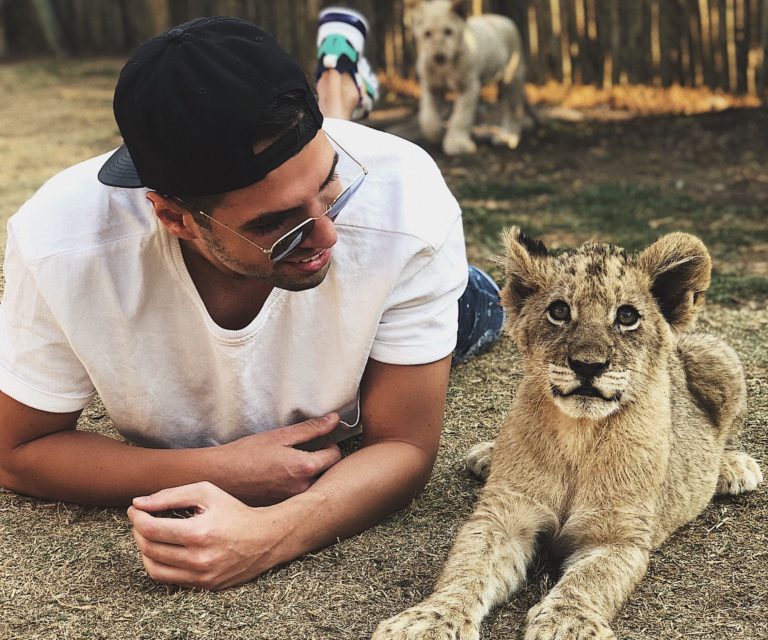
I had the incredible opportunity to see lion cubs just a few months old and play with them. That was the most unique thing about the whole safari, and the entire journey was worth it just for those 10 minutes. The cubs are the cutest little creatures in the world. They’re harmless, because they’re still fed on milk and aren’t predatory yet, but one of them scratched me and left me a souvenir on my right arm. The best thing is that, unlike the tigers in Thailand and Bali, none of the animals in the park is drugged. While I was playing with them and taking photos, the question popped into my head: “But why are they so calm – are they sedated?” and of course I asked the woman who looked after them. She told me that sedating animals is strictly forbidden in nature parks, and anyway they’re babies – if they were sedated their organs would be damaged very quickly and they’d die. They aren’t aggressive because they’re used to people, which is why, when they grow up, they don’t attack the vets and the park staff. But if you or I were to wander around next to them, we’d soon find out how sharp their teeth are.
I managed to see Africa’s Big Five, so mission accomplished. There isn’t a great deal to see in Johannesburg. For those of you who want to spend more time there, I can recommend Nelson Mandela Square, where you can eat the most incredible steaks ever, as well as Soweto – literally a city within the city, a suburb of Johannesburg where Nelson Mandela was born, as were many other politicians and sportspeople. You can also visit the Cradle of Humankind (Cradle of the Humankind), where you can learn a lot about the origin and evolution of the human species.

Important!
- Bring comfortable closed shoes, as well as clothes that cover your arms and legs, especially if you’re visiting Africa in summer
- Bring mosquito repellent, because in Africa malaria is one of the most easily transmitted and dangerous diseases
- Don’t wear expensive clothes or jewellery, and avoid the outskirts of the city. It’s also not advisable to go out alone in the evening

Author
Vilislav Alkantara