
Kraków is a city that feels like opening an old book — with heavy covers, yellowed pages and stories that seem to have been waiting just for you to read them again. From your very first steps on the cobbled streets you fall into a particular rhythm: the ringing of bells, the muffled clatter of horse-drawn carriages, the smell of freshly baked obwarzanki and that gentle movement of people across the Main Market Square that turns the city into a living stage. Here the past is present everywhere — in the towers, in the façades, in the shadows of the old gates, in the courtyards that keep memories of kings, merchants, artists, students and travellers.
For a long time Kraków was the heart of Poland — a royal capital, a spiritual and cultural centre, a place through which merchants, rulers, scholars, artists and travellers passed. Today the city combines the historical weight of Wawel, the bustle of the Main Market Square, the artistic soul of Kazimierz and the silence of the places that keep a painful memory of the 20th century. It is precisely this many-layered character that makes a trip to Kraków such a powerful experience — here you can admire, reflect, wander aimlessly, taste something delicious and leave with the feeling that the city has left its mark.
For me, Kraków is one of those places you experience with all your senses. The taste of traditional Polish pierogi, a stroll along the Vistula, the light on the rooftops of the Old Town, the evening music around St Mary’s Basilica and the feeling of having arrived in a city with a deep memory — all of this stays with you long after the trip. Here every walk can become a small discovery, every façade can make you stop, every street can lead you to a story you weren’t looking for, yet it is exactly that story that makes your journey more meaningful.
Kraków is a wonderful choice for a long weekend, a cultural trip, a romantic getaway or a first encounter with Poland. The city is orderly, accessible, full of sights and at the same time cosy enough to feel close to you from the very first day. Kraków is a journey through beauty, memory and human stories.
In this article I have gathered the top 18 most interesting sights in the old capital Kraków, as well as some tips that will make your stay there even more exciting and interesting.

How to get there?
Fortunately, travelling from Bulgaria to Kraków is now extremely convenient, as there are direct flights from Sofia with Wizz Air and Ryanair. Both airlines operate flights on this route, and prices are often very good, especially if you book early or have flexible dates.
Kraków’s airport — John Paul II International Airport Kraków-Balice — is located relatively close to the city. One of the most practical ways to get to the centre is bus 300, which connects the airport with the city. My personal recommendation is exactly the bus, because it is easy, direct and convenient, especially if you have little luggage. Under the current fares, a 15-minute ticket costs 4 złoty, but for a journey from the airport it is usually safer to buy a 60-minute ticket for zones I+II+III, which costs 8 złoty, as the airport is outside the city centre itself. Tickets can be bought from a machine at the airport, at the stop or directly on the bus, and a paper ticket must be validated immediately after boarding.
When to visit Kraków?
Kraków is a city that can be visited all year round, but the most pleasant months for walking are spring and autumn. In April, May, September and October temperatures are usually milder, the city is lively but not so crowded, and strolls around the Old Town, Kazimierz and along the Vistula are a real pleasure. Spring brings a feeling of freshness, the gardens around Wawel come to life and the squares gradually fill with people. Autumn, for its part, gives Kraków a particular softness — the façades look even warmer, the cafés become cosier and the city seems to take on a more intimate rhythm.
Summer is also a good option, especially if you love longer days, evening walks and a lively atmosphere. At that time, however, Kraków is busier, and popular places such as Wawel, the Rynek Underground Museum, Oskar Schindler’s Factory museum and the Wieliczka Salt Mine are best booked in advance. Winter has its own charm, especially around the Christmas markets on the Main Market Square. If you love a festive atmosphere, lights, mulled wine and chilly walks around the city, Kraków in December can be a very beautiful choice. The winter fairytale is completed by the fact that Kraków is home to one of the most magical Christmas markets in Europe.
Where to stay?
My personal choice for a stay in Kraków would be a hotel or apartment in the Old Town. It is the most convenient area for a first visit, because most of the main sights are within walking distance — the Main Market Square, St Mary’s Basilica, the Town Hall Tower, St Florian’s Gate, the Barbican, the Czartoryski Museum and Wawel. When you stay in the old part, the city literally begins at your hotel door. You can pop out in the morning for coffee, stroll to the Rynek, come back for a short rest and in the evening be in the middle of everything again.
Another very good option is Kazimierz — Kraków’s Jewish quarter, which today is one of the most interesting and artistic areas of the city. The atmosphere there is more bohemian, with lots of restaurants, bars, galleries, small hotels and apartments with character. Kazimierz suits people who want to be close to the centre but also to experience the slightly different, livelier and more alternative side of Kraków. From the quarter you can easily walk both to the Old Town and to the Podgórze district, where Ghetto Heroes Square and Oskar Schindler’s Factory museum are located.
How to get around the city?
Kraków is extremely easy to explore on foot. The Old Town is compact, Kazimierz is close by, and the walk from the Barbican to Wawel along the so-called Royal Route is one of the best ways to get a feel for the city. Although Kraków has a well-developed network of trams and buses, for a sightseeing trip I would personally recommend getting around mainly on foot. That way you will see more details — façades, inner courtyards, small churches, street musicians, shop windows, cafés and those moments that rarely make it onto lists of sights but often stay most vividly in your memory.
Public transport, however, is handy when you want to reach more distant places or when the weather is bad. Tickets are valid on both buses and trams, and the system is time-based — 15, 30, 60 or 90 minutes, as well as day passes. It is important to validate your ticket if it is a paper one, because an unvalidated ticket is treated as invalid. For a short trip in the centre a 15- or 30-minute ticket may be enough, but for the airport and longer routes it is better to get a 60-minute or 90-minute ticket.
Which local dishes to try?
Kraków is a wonderful place to get to know Polish cuisine, which is filling, homely, rich in flavour and perfect for cooler weather. First and foremost, of course, come pierogi — traditional Polish dumplings that can have various fillings: potato and cheese, meat, cabbage and mushrooms, spinach, sweet curd cheese or fruit. This is one of the dishes you absolutely must try, because it is served almost everywhere and is a true classic.
Another very characteristic dish is żurek — a sour soup made from fermented rye flour, often served with sausage and egg. At first the taste may sound unusual, but this is one of the most recognisable Polish soups. Also try bigos, known as “hunter’s stew”, with cabbage, meat and spices, as well as placki ziemniaczane — potato pancakes, often served with sour cream or goulash.
For something quick and typically Kraków, look for obwarzanek krakowski — a ring-shaped bread sold from little blue carts around the city. It is part of Kraków’s daily rhythm and perfect as a snack during a walk. If you have a sweet tooth, try sernik — Polish cheesecake, as well as pączki — filled doughnuts found in many bakeries. And if you end up in a traditional restaurant, order several different dishes to share — Polish cuisine is best enjoyed at the table, with time and curiosity.

What to see in Kraków?
Wawel Royal Castle (Zamek Królewski na Wawelu)
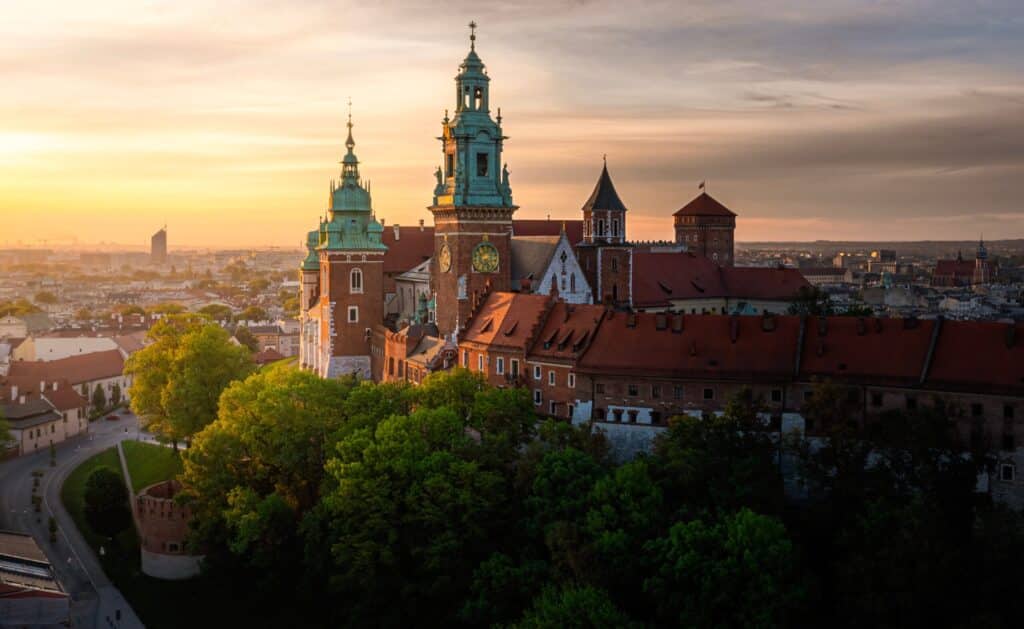
Wawel Castle is the most iconic place in Kraków and one of the great symbols of Poland. Set on a hill above the River Vistula, for centuries it was the residence of the Polish kings and the centre of political power. As soon as you approach the hill you can feel its weight — the fortifications, the towers, the courtyards and the views of the river create the sense of a place that has witnessed coronations, dynastic struggles, wars, rises and dramatic historical twists.
Wawel is not just one castle, but a whole complex of architecture, museums, courtyards, gardens and legends. Inside you can explore the State Rooms, the Treasury, the Armoury, the Private Royal Apartments and seasonal routes. Particularly beautiful is the Renaissance arcaded gallery in the inner courtyard, which gives the complex an Italian elegance. If you are travelling to Kraków for the first time, Wawel should be among the first places on your route, because it is here that your understanding of the city’s royal and historical identity begins.
Entrance fee: The courtyard and the hill can be explored for free; tickets for the interiors vary by route — for example about 57 złoty for a single floor and about 95 złoty for a combined ticket, i.e. roughly 13–22 euros.
Useful tip: Decide in advance which parts you want to see, because tickets are sold by route and with time slots. For a first visit, combine the courtyard, the cathedral, the State Rooms and a walk along the Vistula.

Wawel Cathedral (Katedra Wawelska)
Wawel Cathedral is one of the most sacred places in Poland. Polish rulers were crowned here, and kings, national heroes, poets and important historical figures are buried here. Entering the cathedral is an encounter with Polish memory in its most concentrated form — Gothic vaults, chapels, sarcophagi, symbols of power and a sense of an unbroken bond between religion, state and national identity.
One of the most interesting parts of the visit is the climb to the Sigismund Bell — a huge Renaissance bell regarded as one of the symbols of Kraków. According to local tradition, if you touch the bell’s clapper with your left hand and make a wish, it may come true. Of course, even without the legends, the cathedral impresses with its architecture, history and atmosphere. It is a place best explored slowly, because every chapel and every detail tells a separate page of Poland’s history.
Entrance fee: About 26 złoty, roughly 6 euros, and the ticket includes the cathedral museum, the royal tombs and the Sigismund Bell.
Useful tip: Treat the cathedral as a separate experience from the castle itself. It is best visited in the morning or earlier in the day, before the groups become too numerous.

Dragon’s Den (Smocza Jama)
The Dragon’s Den is one of the most curious and fairytale-like sights in Kraków, located on the western side of Wawel Hill. It is linked to one of the city’s best-known legends — that of the Wawel Dragon, which according to tradition lived in the cave beneath the castle and struck fear into the local people. The story tells how the dragon was defeated by cunning, and the legend remains part of Kraków’s identity to this day. That is exactly why this place is so loved — it adds a mythological, almost childlike charm to the otherwise majestic and royal image of Wawel.
The cave itself is quick to explore, but the experience is interesting, especially if you have already visited the castle and want to finish your walk in a different way. The entrance is from Wawel Hill, and the route takes you down through the limestone cave until you come out near the River Vistula. That is also where you will find the famous statue of the Wawel Dragon, which periodically breathes real fire and almost always draws a crowd of tourists, families and children. The cave is a seasonal attraction and in 2026 it is open from 24 April to 31 October.
Entrance fee: About 15 złoty, roughly 3.50 euros. The ticket also includes access to the Royal Gardens during their open season.
Useful tip: Plan the Dragon’s Den after visiting Wawel Castle and Wawel Cathedral, because the exit naturally leads you to the river and the dragon statue. Bear in mind that there are stairs inside and it is cooler.

Vistula Boulevards (Bulwary Wiślane)
The promenade along the River Vistula is one of the most pleasant places for a stroll in Kraków. The river flows calmly past Wawel and opens the city up to a wider space, with views of the castle, the bridges and the green banks. After a few hours in the narrow streets of the Old Town, a walk along the Vistula brings a feeling of air and lightness. It is a place where the city becomes slower, softer and more contemplative.
It is especially beautiful at sunset, when the light falls on Wawel and people stroll, cycle or simply sit by the river. You can walk past the statue of the Wawel Dragon, continue towards the bridges or hop on a short boat trip if the weather is good. This is one of those parts of Kraków that don’t require an entrance ticket but give you a great deal of the city’s atmosphere.
Entrance fee: Free.
Useful tip: Plan your walk along the Vistula after visiting Wawel. The route continues naturally from the hill to the river and is wonderful for photos.

Main Market Square (Rynek Główny)
The Main Market Square is the heart of Kraków and one of the most impressive urban spaces in Europe. Vast, harmonious and surrounded by beautiful historic buildings, the square brings together everything that makes Kraków so appealing — architecture, history, music, restaurants, street performers, horse-drawn carriages and constant movement. Some of the most important sights in the city are here: St Mary’s Basilica, the Cloth Hall (Sukiennice), the Town Hall Tower and the entrance to the Rynek Underground Museum.
The square has a particularly strong atmosphere early in the morning, when the city is still waking up, and in the evening, when the lights soften the façades and the music and voices blend into one lively urban rhythm. It is a place you will probably pass through every day, even without planning to. It is here that Kraków feels most theatrical — like a stage on which the centuries keep moving together with the people.
Entrance fee: Free.
Useful tip: Pass through the square at least three times — in the morning, in the afternoon and in the evening. Each time the atmosphere is different, and the view of the basilica and the Cloth Hall changes with the light.

Town Hall Tower (Wieża Ratuszowa)
The Town Hall Tower is the only surviving fragment of Kraków’s old town hall, which once stood on the Main Market Square. Built in the Middle Ages, the tower is a symbol of civic power and of Kraków’s self-government. Today it stands as a solitary but very strong architectural accent in the space of the Rynek — tall, Gothic and slightly leaning, with a presence that recalls the time when the square was an administrative and commercial centre.
Climbing the tower is a short but interesting experience. Inside there are narrow stairs and small exhibitions, and from the top there is a lovely view of the Main Market Square and the rooftops of the Old Town. It is not the biggest museum in Kraków, but it is a great stop if you want to see the square from a different perspective and feel the vertical silhouette of the old town.
Entrance fee: About 22 złoty, roughly 5 euros.
Useful tip: The stairs are narrow and steep, so don’t plan your visit for a moment when you are tired. It is best to climb on a clear day.

Rynek Underground Museum (Rynek Underground / Podziemia Rynku)
The Rynek Underground Museum is one of the most interesting places in Kraków, because it literally takes you beneath the surface of the Main Market Square. Located under the Cloth Hall, the museum displays archaeological remains, medieval trade routes, old paving, everyday objects and multimedia installations that tell how Kraków developed as a commercial and cultural centre. It is a place that makes history far more tangible — you see the layers of the city on which thousands of people walk today.
The museum is particularly suited to history lovers, but also to people who want a more modern and interactive experience. Here the past is presented not only through display cases, but through sound, light, reconstructions and atmosphere. A walk through the underground helps you imagine medieval Kraków as a bustling trading centre, where different cultures, goods, languages and destinies met.
Entrance fee: About 36 złoty, roughly 8.50 euros. Entry is free on Tuesdays, but tickets are limited and must be collected on site.
Useful tip: Book in advance, because the museum is popular and entry is by time slot. It is a great choice for a rainy day.

St Mary’s Basilica (Bazylika Mariacka)
St Mary’s Basilica is one of the most recognisable buildings in Kraków and an architectural gem of the Main Market Square. Its two towers of different heights immediately catch the eye, and every hour the famous trumpet call, the hejnał mariacki, sounds from the taller tower. The melody breaks off abruptly, according to legend in memory of the trumpeter who warned the city of an attack but was struck by an arrow. This small ritual gives the square a special rhythm and is one of Kraków’s most distinctive traditions.
The interior of the basilica is exceptionally beautiful — rich colours, a starry sky, stained-glass windows and above all the magnificent wooden altarpiece by Veit Stoss, considered one of the masterpieces of late Gothic art in Europe. Even if you are not someone who usually visits many churches while travelling, this basilica deserves your attention. It is not only a place of worship, but also an artistic treasure.
Entrance fee: About 20 złoty, roughly 5 euros.
Useful tip: Stay on the square at the top of the hour to hear the trumpet call. Then go into the basilica and take time over the altarpiece, because its details are impressive.

Kazimierz, the Jewish Quarter (Kazimierz)
Kazimierz is one of the most atmospheric neighbourhoods in Kraków. Once a separate town and later an important centre of Jewish life, today it is a district of many layers — synagogues, old streets, artistic spaces, galleries, restaurants, vintage shops and bars that fill with people in the evening. Kazimierz carries memory, but also creative energy. It is precisely this combination that makes it such a powerful experience.
A walk around Kazimierz is best without too tight a plan. Go along Szeroka Street, see the Old Synagogue, notice the little squares, the murals, the old façades and the restaurants serving Jewish cuisine. The quarter is also connected with the film “Schindler’s List”, parts of which were shot right here. Today Kazimierz is one of the liveliest places in the city — great for dinner, a cocktail, a long walk or simply watching city life.
Entrance fee: Free to walk around the quarter. Individual synagogues and museums have separate fees.
Useful tip: Visit Kazimierz both during the day and in the evening. A daytime walk reveals its history, while the evening shows its more bohemian side. There are also quite a few interesting restaurants there.

Ghetto Heroes Square (Plac Bohaterów Getta)
Ghetto Heroes Square is one of the most powerful memorial spaces in Kraków. It is located in the Podgórze district, where the Kraków Ghetto was established during the Second World War. Today the square is marked by an installation of empty metal chairs — a symbol of the people who were taken from their homes, gathered at this spot and deported to the camps. The space is quiet, restrained and moving.
This is not a place to pass through quickly. The square demands a pause, because it speaks through absence. Every chair looks like a trace of a person, of a home, of a life violently cut short. Nearby is the Pharmacy Under the Eagle, which played an important role in the history of the ghetto. If you are planning to visit Oskar Schindler’s Factory museum, it makes a lot of sense to combine the two places in one route.
Entrance fee: Free.
Useful tip: Go before or after Oskar Schindler’s Factory museum, to connect the place with the wider historical context of Kraków during the Second World War.

Kraków Barbican (Barbakan Krakowski)
The Kraków Barbican is one of the best-preserved medieval defensive structures in Europe. Built at the end of the 15th century, it served as part of the city’s defence system and was connected to St Florian’s Gate. With its massive walls, round shape and loopholes, the Barbican looks like a set from a historical film, but it is in fact a real witness to Kraków’s military past.
Today it is a museum space and one of the beautiful architectural highlights around the Old Town. Even from the outside the Barbican is impressive — especially if you see it from the Planty, the ring of gardens that encircles the old centre. A visit inside is relatively short, but interesting if you love medieval architecture and city fortifications.
Entrance fee: About 22 złoty, roughly 5 euros.
Useful tip: Combine the Barbican with St Florian’s Gate and a walk through the Planty. That way you will get a sense of how the former city walls once formed the boundary of old Kraków.

St Florian’s Gate (Brama Floriańska)
St Florian’s Gate is one of the most beautiful remnants of Kraków’s medieval fortifications. The Royal Route passed through it — the route by which rulers and important processions entered the city and headed towards Wawel. Today the gate links the area around the Barbican with Floriańska Street, one of the liveliest and most beautiful streets in the Old Town.
The spot is especially photogenic because it combines the feel of an old town, fortress architecture and lively movement. People constantly pass under the arch of the gate, and around it there are often street performers and paintings on display. It is a great starting point for a walk towards the Rynek, because it ushers you into the Old Town in a way that carries historical symbolism.
Entrance fee: Free to walk through and view from outside. A visit to the defensive walls is about 22 złoty, roughly 5 euros.
Useful tip: Start your walk at the Barbican, go through the gate and continue along Floriańska Street to the Main Market Square — this is one of the most classic routes in Kraków.

Czartoryski Museum (Muzeum Książąt Czartoryskich)
The Czartoryski Museum is one of Kraków’s most precious cultural treasures. Founded by Princess Izabela Czartoryska, it is among the oldest museums in Poland and holds an exceptionally important collection of European art, historical objects, weapons, documents and antiquities. The most famous exhibit here is “Lady with an Ermine” by Leonardo da Vinci — one of the few paintings by Leonardo that can be seen in a museum outside Italy and France.

A visit to this museum is a special experience, because it is not just about one famous painting. The whole collection carries the spirit of the Polish aristocracy, European taste and the idea of memory as cultural heritage. The space is beautifully arranged, and the encounter with “Lady with an Ermine” is a moment that stays in your mind. The painting is smaller and more intimate than you might imagine, but its presence is extraordinarily strong.
Entrance fee: About 65 złoty, roughly 15 euros. Every Tuesday entry to the permanent exhibitions is free.
Useful tip: Book a timed ticket in advance, especially if you are travelling at the weekend. Even if your main goal is “Lady with an Ermine”, do set aside time for the rest of the collection too.

Museum of Illusions (Muzeum Iluzji Krakil)
The Museum of Illusions is a lighter, fun stop in Kraków, especially if you are travelling with children or friends, or simply want something different between the historical sights. The focus here is on optical illusions, interactive installations, mirrors, perspectives and visual effects that play with perception. It is a place for photos, experiments and a short break from the more serious rhythm of the museums.
The visit doesn’t take much time, but it can be a pleasant change, especially on a rainy day or if you have already covered the main historical sites. The museum is close to the centre, which makes it easy to fit into your route. Don’t expect a classic museum with an in-depth historical exhibition — the idea here is experience, playing with images and fun.
Entrance fee: About 55–59 złoty per adult, roughly 13–14 euros. There are reduced and family tickets.
Useful tip: Visit it at a freer moment in your schedule, when you need something lighter. It is ideal for photos and a short break from the historical routes.

Oskar Schindler’s Factory (Fabryka Emalia Oskara Schindlera)
Oskar Schindler’s Factory museum is housed in the former enamelware factory linked to the story of the industrialist Oskar Schindler, who saved the lives of more than 1,000 Jews during the Holocaust. Today the site has been turned into a museum devoted not only to Schindler, but also to life in Kraków under Nazi occupation between 1939 and 1945. It is one of the most powerful and important exhibitions in the city.
The museum is moving because it presents history through documents, photographs, reconstructions, personal stories and atmosphere. It tells not just of one name, but of a whole city subjected to violence, fear and destruction. The visit requires time and inner readiness, because the subject is a heavy one. If you are interested in the history of the Second World War, this is an absolute must in Kraków.
Entrance fee: Individual tickets are usually about 32–36 złoty, roughly 8 euros. Organised tours in English are more expensive, about 90 złoty.
Useful tip: Buy your ticket in advance, because the museum is very popular. Combine it with Ghetto Heroes Square and Kazimierz for a fuller understanding of the history.

Wax Museum (Muzeum Figur Woskowych)
The Wax Museum in Kraków is more of a fun, light attraction, suitable for a short visit, especially if you are in the Old Town area and want something unpretentious. In it you will see wax figures of famous people from various fields — film, music, politics, sport and pop culture. It is the type of place you get round relatively quickly and is aimed more at photos and entertainment.
The museum doesn’t have the weight of Kraków’s historical sites, but it can be a pleasant stop if you are travelling with children or if the weather outside isn’t good. It is important to approach it as a fun attraction rather than a major cultural museum. Its biggest advantage is its central location and the fact that it can easily be fitted in between two more serious visits.
Entrance fee: About 25–50 złoty depending on the source and ticket type, roughly 6–12 euros.
Useful tip: Visit it only if you have spare time or are travelling with children. On a first visit to Kraków I would give priority to the historical museums and Wawel.

Wieliczka Salt Mine (Kopalnia Soli Wieliczka)
The Wieliczka Salt Mine is one of the most impressive places around Kraków and one of the most popular day trips from the city. The mine operated for centuries and today is a UNESCO World Heritage Site. The visit takes you deep underground, through tunnels, chambers, lakes, salt sculptures and vast spaces carved by human labour and time. The most impressive part is the Chapel of St Kinga — an underground cathedral of salt that looks almost unreal.
It is a place that is hard to compare with any other sight. Wieliczka combines industrial history, religious art, the natural environment and human ingenuity. The tourist route is well organised and is usually visited with a guide. Bear in mind that the temperature inside is lower and the route involves a lot of stairs at the beginning. Even so, the experience is well worth the half day you set aside for it.
Entrance fee: About 159 złoty for a standard ticket, roughly 37 euros.
Useful tip: Book in advance and bring a light jacket. It is most convenient to plan Wieliczka as a separate half-day trip from Kraków.

Auschwitz-Birkenau Concentration Camp (Auschwitz-Birkenau)
Auschwitz-Birkenau is a place to be visited with respect, silence and inner readiness. Located near the town of Oświęcim, about an hour and a half from Kraków, the memorial complex is one of the most important historical sites in Europe and a symbol of the Holocaust. The visit includes two main sites — Auschwitz I, with the brick blocks housing the exhibitions, and Auschwitz II-Birkenau, the vast area of barracks, railway tracks, ruins of crematoria and an endless sense of the scale of the tragedy.
This is not an ordinary tourist attraction. It is a place of remembrance that changes the way you perceive history. The exhibitions are heavy, documentary and deeply affecting. It is best to visit with a licensed guide, because the context is important and the scale of what happened is hard to grasp through an independent walk alone. After such a visit, it is wise not to plan too many other activities for the same day.
Entrance fee: Entry to the memorial complex is free, but an entry pass must be reserved. Guided visits and organised transport from Kraków are paid separately and prices vary by operator.
Useful tip: Book a slot in advance and set aside almost a whole day. Prepare yourself mentally for a heavy but very important experience.


Author
Vilislav Alkantara