
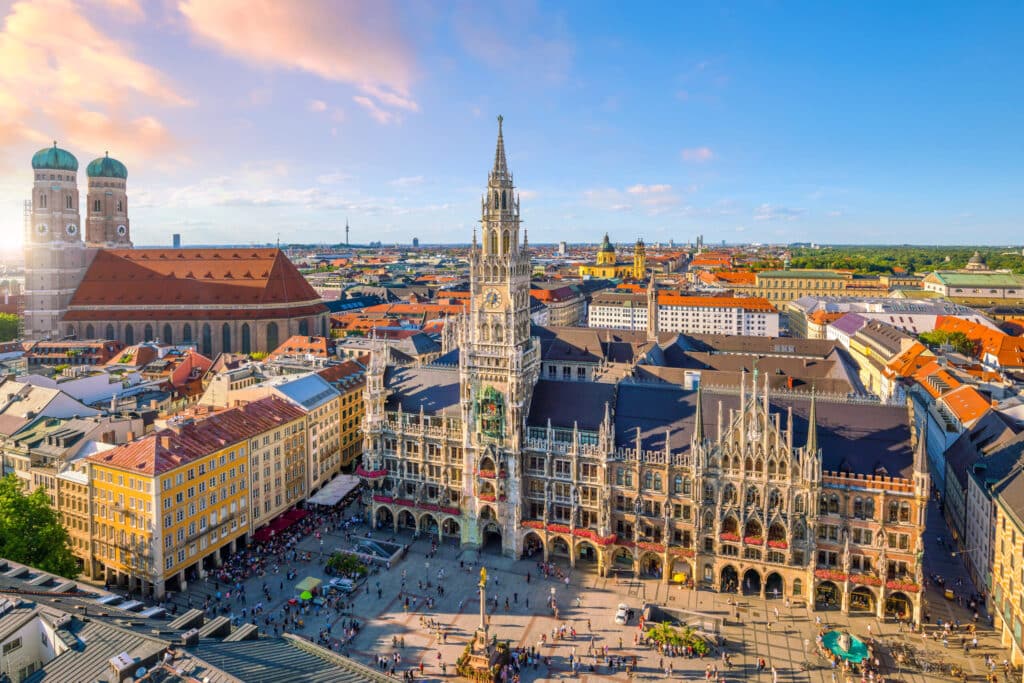
Bologna isn’t just another pretty Italian city. It’s the heart of Emilia-Romagna – a storyteller, a keeper of secrets and a master chef of legendary recipes. The moment you step under its covered arcades, time seems to slow down and let you into a calmer, deeper world, one where past and present embrace like old friends. There’s no need to rush here. Bologna will invite you to get lost in it all by itself.
With its nicknames La Dotta (the learned), La Grassa (the fat) and La Rossa (the red), the city shows off its three faces: cultural capital, foodie paradise and architectural gem. It’s home to the oldest university in the world, and it’s where flavours are born that linger long after your last bite of handmade tagliatelle ‘Bolognese’. The red-brick façades, warm and full of colour, make you feel instantly at ease, as if Bologna is welcoming you with open arms and whispering that you’re already home. Every corner, every arch, every façade tells a story – of student uprisings, of old love letters, of laughter and music echoing down the narrow lanes. Bologna doesn’t try to dazzle you with grand gestures. It speaks softly, but it stays with you for ever.
Whether you climb up to San Luca along the never-ending arcade, wander down Via del Pratello with its bars and street performers, or simply perch on the stone rim of the Fountain of Neptune with a gelato in hand, everything here invites you to live in the moment. Bologna is a city for people who look not just with their eyes but with their soul. For those who value the silence between words, the flavour behind simplicity and the beauty in imperfection.
In this article I’ve gathered the 20 most interesting sights in Bologna, along with a few tips to make your stay even more exciting and memorable.

How to get there
Bologna is an easy place to reach, especially from Sofia, thanks to direct flights with the low-cost airlines Ryanair and Wizz Air, as well as the national carrier Bulgaria Air. The flight takes about 1 hour 50 minutes, which makes the city perfect for a weekend getaway or a longer holiday combined with a trip to Florence.
Once you land at Bologna’s Guglielmo Marconi Airport, the easiest way into the city centre is the Marconi Express. This driverless shuttle train links the airport with Bologna’s central station in around 7 minutes. Tickets cost about 12 euros one way. Alternatively, the TPER BLQ bus line will also take you into the centre.
When to visit Bologna
The best time to visit Bologna is in spring (April to June) and autumn (September to October), when the weather is mild and the city isn’t overrun with tourists. Summer can be pretty hot and humid, while winter is quiet but has fewer events and things going on.
In spring and autumn you can also enjoy plenty of festivals, exhibitions and food events that reveal Bologna’s cultural and culinary soul.
Where to stay
If you want to be in the thick of it all, your best bet is the centre, around Piazza Maggiore. From here almost all the main sights and restaurants are within walking distance. For a quieter stay that’s still close to the centre, try the area around Porta San Felice or Santo Stefano.
For cheaper options, or if you’re travelling by car, the streets around the railway station (Bologna Centrale) are also handy and offer a good range of hotels and hostels.
Getting around the city
Bologna is a wonderful city for walking. Most of the sights are clustered in the historic centre and are easy to reach on foot. The city is famous for its arcades, which give you shade and shelter from the rain – perfect for a stroll whatever the weather.
If you want to get from A to B more quickly, use the TPER bus network. Tickets cost around 1.50 euros and are valid for 75 minutes. You can buy them at tobacconists, from ticket machines or via the mobile app.
Which local dishes to try
Bologna is considered the food capital of Italy. You simply have to try tagliatelle al ragù (better known as Bolognese, although the locals never call it that). Fresh pasta is an art form here – tortellini, lasagne and tagliolini are just part of a very rich menu.
Don’t miss mortadella – a delicate, slightly sweet cured sausage that’s a symbol of the city. Parmigiano Reggiano and balsamic vinegar from the region, both widely used in the local cooking, are well worth trying too.

What to see in Bologna
Piazza Maggiore
The heart of Bologna’s historic centre, Piazza Maggiore is more than just the main square – it’s the city’s living stage. Ringed by imposing medieval buildings, it’s the starting point for almost every tour. Some of the city’s most iconic buildings stand here: the Basilica of San Petronio, Palazzo d’Accursio and Palazzo del Podestà. The atmosphere is grand and laid-back at the same time, with street musicians, café terraces and tourists drinking in the beauty of Bologna.
Don’t miss the Fountain of Neptune (Fontana del Nettuno) right next to the square. This monumental 16th-century sculpture is the work of Giambologna and one of the symbols of the city. Neptune, shown in all his glory, is surrounded by mermaids and sea creatures symbolising the power of the papacy over the seas. The locals jokingly call him “Il Gigante” (the Giant).
Top tip: Sit on the edge of the fountain with a coffee or a gelato and watch life go by – a true Italian experience.

Basilica of San Petronio (Basilica di San Petronio)
This massive Gothic basilica is one of the most impressive churches in Italy and the fifth largest in the country. Curiously, for all its enormous size, its façade was never finished, which gives the building a distinctive, “raw” charm. Inside you’ll find remarkable frescoes, including one showing the Prophet Muhammad in hell – a scene that has stirred up controversy over the years.
The basilica is also home to the longest meridian line in the world, set into the floor – a 17th-century scientific breakthrough used to calculate astronomical data. That makes it not only a religious site but a scientific one too.
Admission: Entry to the basilica is free. The panoramic terrace costs 3 euros.
Top tip: The climb up to the roof is worth it – you’ll have Piazza Maggiore and the whole city at your feet.

The Two Towers – Asinelli and Garisenda (Le Due Torri – Asinelli e Garisenda)
Bologna’s most recognisable symbol, these two leaning towers survive from the days when aristocratic families built such structures to show off their wealth and influence. The Asinelli Tower is open to visitors and offers an unforgettable panoramic view over the “red” city.
The Garisenda Tower is shorter and leans much more, so you can’t climb it, but it’s an impressive sight. The two towers stand right in the heart of the old town and make an excellent landmark for finding your bearings.
Admission: About 5 euros to climb the Asinelli, and it’s highly recommended to buy your tickets online in advance.
Top tip: Wear comfortable shoes – the stairs are narrow and steep, but the view is absolutely worth it.

The Porticoes of Bologna (Portici di Bologna)
With more than 40 kilometres of covered arcades, Bologna has a look all of its own. The porticoes don’t just make the city beautiful – they’re a practical shelter from rain and sun as well. They’re on UNESCO’s World Heritage List and make you feel as if you’re strolling through an open-air gallery.
Among the most impressive are the arcades leading up to the Sanctuary of San Luca – more than 600 arches snaking up the hill, an unforgettable experience for any pilgrim or tourist.
Admission: Free
Top tip: Take a walk under the arcades in the evening – lit by the street lamps, they feel romantic and mysterious.

Palazzo d’Accursio
Palazzo d’Accursio, once Bologna’s town hall, stands right on Piazza Maggiore and is a true architectural treasure. The complex mixes styles from medieval to Renaissance and houses both council offices and cultural spaces. Inside you’ll find the Municipal Art Collections, as well as the council chamber with its beautiful murals.
The top-floor terrace has a lovely view over the square and the city’s red rooftops. The building itself is so imposing that you can’t miss it, even on the shortest stroll around the centre.
Admission: Main entrance – free. The Gallery and special rooms – 6 euros.
Top tip: Head up to the terrace in the late afternoon – the light is perfect for photos.

Palazzo del Podestà
Built in the 13th century, Palazzo del Podestà was the seat of local government in the Middle Ages. The building wows with its vaulted halls and Gothic façade. One of its most intriguing features is the “Whispering Gallery” under the central part of the palace: whisper something into the wall and someone on the other side will hear it – an acoustic quirk that delights visitors.
The palace often hosts exhibitions and cultural events, and its courtyard is a pleasant spot to escape the bustle of the city.
Admission: The ticket price depends on the exhibition on at the time.
Top tip: Test the acoustics with a friend – the effect is genuinely surprising and great fun.

Palazzo Re Enzo
Right next to Palazzo del Podestà, Palazzo Re Enzo is one of the most striking buildings in central Bologna. Built in the 13th century, it’s named after King Enzo, son of Emperor Frederick II, who was taken prisoner and spent the rest of his life right here. Its history gives it a mysterious, romantic aura that you sense the moment you step through the door.
Today the palace is used for cultural events, exhibitions and conferences. Its architecture is a photographer’s dream – the façade, the vaults and the courtyard make a perfect backdrop for memorable shots.
Admission: The ticket price varies with the event.
Top tip: Come in the evening, when the façade is beautifully lit and the atmosphere becomes even more magical.

The University of Bologna (Università di Bologna)
Founded in 1088 and considered the oldest university in the world, the University of Bologna played a huge part in shaping European education. Over the centuries figures such as Dante Alighieri, Nicolaus Copernicus and Erasmus of Rotterdam taught here. The university buildings are scattered all over the city, but the most famous is the Archiginnasio – the old home of the faculties of medicine and law.
Today the university draws thousands of students from all over the world and fills the city with youthful energy. A visit is not only a trip through history but a chance to feel the pulse of modern Bologna.
Admission: The outside areas are free. Museums and exhibitions cost from 3 to 8 euros.
Top tip: To dodge the crowds, visit on a weekday morning, when the campus is quieter.

The Archiginnasio (Archiginnasio di Bologna)
The Archiginnasio is one of Bologna’s most remarkable buildings. Built in the 16th century as the university’s main building, today it houses a historic library and the Anatomical Theatre, where dissections were once demonstrated to medical students. The interior is covered with thousands of coats of arms of former students and teachers – a truly unique sight.
The Anatomical Theatre, made entirely of wood, is striking in its elegance and symbolism. Pride of place goes to the “professor’s chair”, flanked by figures representing medicine and science.
Admission: About 3 euros.
Top tip: Don’t miss the library – it’s one of the oldest and most beautiful in Italy.

The little canal window on Via Piella (Finestrella di Via Piella)
One of Bologna’s most charming “hidden” sights is a tiny window set into a wall on Via Piella, which opens onto the secret Canale delle Moline. The view looks like a little Venice tucked away behind the brick façades. The canal is part of the city’s old water system, which once powered mills and workshops.
The spot is especially popular for Instagram shots and often takes tourists by surprise – nobody expects to see water in an otherwise “dry” city like Bologna.
Admission: Free.
Top tip: Go early in the morning or towards evening, when there are fewer people around and the light is better for photos.

A cookery class in Bologna
One of the most authentic ways to get under Bologna’s skin is through its food – and what better way than learning to cook it yourself? The city has plenty of cookery classes that teach you how to make homemade tortellini, tagliatelle al ragù and even classic Italian gelato. They’re run by experienced local cooks and often take place in traditional kitchens or on farms on the outskirts.
Besides new skills in the kitchen, you’ll come away with new friends, a delicious dinner at the end of the class and unforgettable memories. Most classes are in English and last between 3 and 5 hours.
Price: Between 70 and 100 euros, depending on the programme.
Top tip: Book online in advance – the good classes fill up fast, especially at weekends.

Basilica of Santo Stefano (Basilica di Santo Stefano)
Also known as the “Seven Churches”, the Basilica of Santo Stefano is one of the most mystical and spiritual complexes in Bologna. Built on the remains of a Roman temple, it blends several architectural styles, from early Christian to Romanesque. There were once seven interconnected churches here; four survive today, each with its own character and role.
Inside you’ll find beautiful mosaics, ancient crypts and peaceful courtyards. It’s a wonderful place to rest, reflect and escape the noise of the tourist streets.
Admission: Free.
Top tip: Visit early in the morning, when it’s at its quietest and you can really feel the magic of the place.

Sanctuary of the Madonna of San Luca (Santuario della Madonna di San Luca)
Perched on a hill south-west of Bologna, this sanctuary is an iconic place of pilgrimage and one of the city’s best-known landmarks. You reach it along the longest covered arcade in the world – 3.8 kilometres and 666 arches, starting at Porta Saragozza. The climb is an experience in itself, and the view from the top rewards every bit of effort.
The church holds an icon of the Madonna and Child said to have been brought from the Holy Land. The sanctuary is especially beautiful at sunset, when the sun bathes the city in warm hues.
Admission: Free. The panoramic terrace costs around 5 euros.
Top tip: If you don’t fancy the climb on foot, you can take a bus to the start of the arcade and carry on from there.

Certosa Cemetery (Cimitero della Certosa)
Bologna’s Certosa Cemetery is one of the most striking and mysterious places in the city. Founded in the late 18th century on the remains of a Carthusian monastery, it’s a true open-air museum. Wandering among the mausoleums and sculptures, you sense the spirit of the age, the architectural riches and a deep respect for the past. Famous names from the worlds of art, science and politics are buried here.
The cemetery mixes neoclassical, Gothic and Art Nouveau elements, and every tomb is a unique work of art. The monumental galleries and statues are particularly impressive, giving a sense of grandeur and timelessness.
Admission: Free.
Top tip: Pick up a map at the entrance or download one online – the cemetery is huge and it’s easy to get lost.

Museum of the History of Bologna (Museo della Storia di Bologna)
Housed in the elegant Palazzo Pepoli, this museum takes you on an interactive, gripping journey through Bologna’s history, from the Etruscans to the present day. Through multimedia displays, animations and reconstructions, you learn about the key events, people and symbols of the city. It’s great for adults and children alike.
The rooms are arranged by period and theme, highlighting the city’s contribution to culture and learning, its architectural heritage and its culinary traditions. The 3D reconstruction of medieval Bologna is particularly impressive.
Admission: About 10 euros.
Top tip: Get the audio guide – it’ll make your visit even richer and more interesting.

Porta Galliera and Montagnola Park (Porta Galliera e Parco della Montagnola)
Porta Galliera is one of the best-preserved of Bologna’s historic gates, part of the old city walls. Built in the 13th century and later restored, it was the way in for travellers and merchants arriving from the north. Next to it are the remains of the Galliera fortress, built by Pope John XXII in the 14th century as a symbol of the Church’s power. Only parts of the foundations survive today, but the place still has real historical weight and charm.
Right beside Porta Galliera is Montagnola Park (Parco della Montagnola), one of the oldest public parks in the city. Set on a gentle hill, it has pleasant paths, old statues, a fountain and a lovely view over central Bologna. At weekends there’s often a flea market here, and in summer there are open-air cultural events.
Admission: Free.
Top tip: Come on a Sunday morning to browse the market, then take in the panoramic view from the top of the Montagnola hill.

The National Art Gallery (Pinacoteca Nazionale di Bologna)
This is one of Italy’s most important art museums, home to priceless works from the Middle Ages to the Baroque. The gallery occupies a 16th-century building that was once part of a monastery, and its collection includes works by Italian masters such as Raphael, Guido Reni, El Greco and Cosmè Tura.
A visit here gives you a unique insight into the artistic heritage of Emilia-Romagna, and it’s a must for any art lover. The rooms are spacious and well laid out, so you can lose yourself completely in the art.
Admission: About 8 euros.
Top tip: Go in the morning to beat the crowds and enjoy the exhibits in peace.

Margherita Gardens (Giardini Margherita)
Bologna’s largest public park, the Margherita Gardens are a green gem in the heart of the city. Laid out in the 19th century in the English style, the park has a wide lawn, centuries-old trees, a lake with swans and plenty of benches and paths – ideal for a picnic, a stroll or some exercise. It’s a favourite spot for locals to unwind, especially in spring and summer.
The park often hosts cultural events, open-air exhibitions and farmers’ markets. You’ll also find cosy cafés where you can take a break surrounded by nature.
Admission: Free.
Top tip: Perfect with children, or if you fancy a green break from sightseeing.

Basilica of San Domenico (Basilica di San Domenico)
The Basilica of San Domenico is one of Bologna’s most important religious buildings and home to the tomb of St Dominic, founder of the Dominican Order. Built in the 13th century, it impresses with its elegant Romanesque-Gothic architecture and the art inside – including sculptures by a young Michelangelo.
The interior is majestic, and the altar and chapels are richly decorated. St Dominic’s tomb, known as the Arca di San Domenico, is a true masterpiece of Renaissance art, the work of several different masters.
Admission: Free. Sometimes there’s a small fee to visit the basilica’s museum.
Top tip: Look out for Michelangelo’s sculptures on St Dominic’s tomb – small, but incredibly precious.

MAMbo Museum of Modern Art (Museo d’Arte Moderna di Bologna – MAMbo)
MAMbo is Bologna’s home of modern and contemporary art. Housed in a converted industrial building, it has a permanent collection devoted to Italian art from the second half of the 20th century to the present day, plus temporary exhibitions by international artists. It’s the perfect place for anyone who wants to see a side of Bologna beyond the traditional.
Highlights include the section devoted to the Arte Povera movement and the rooms of conceptual and minimalist art. MAMbo regularly hosts events, talks and screenings.
Admission: About 6 euros.
Top tip: Drop into the museum’s café-restaurant too – a great spot for a short break among the artworks.

Author
Vilislav Alkantara