
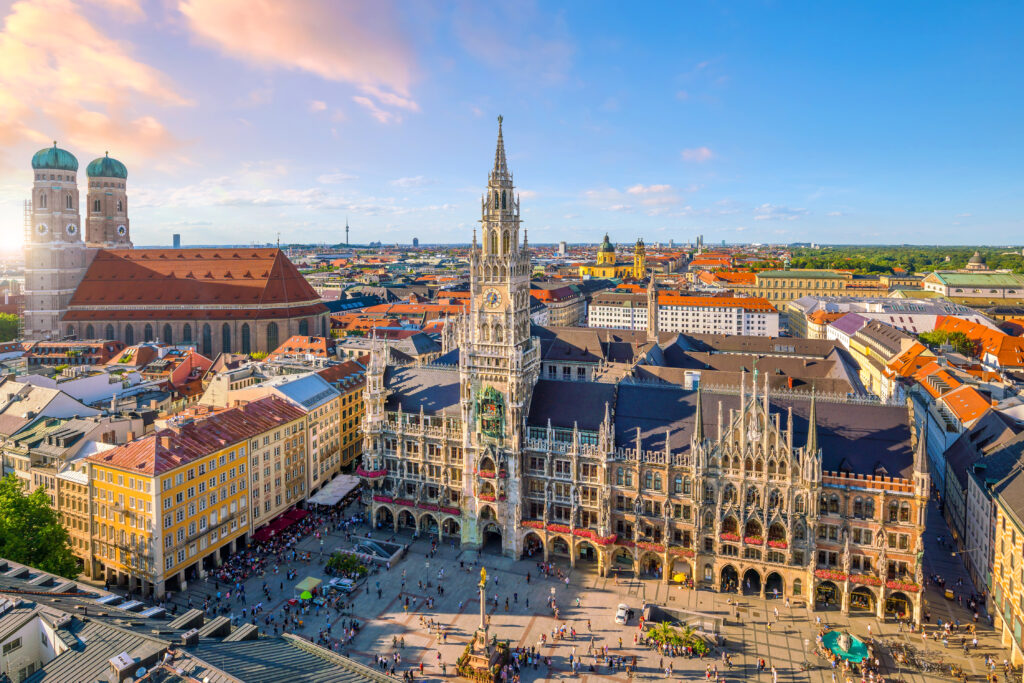
Skopje is definitely not the most beautiful city I’ve ever been to. But it is one of the strangest and most unusual places – and, at the same time, one of the most interesting. In fact, Macedonia is a country with both sentimental and controversial significance for us Bulgarians, but I won’t go into the historical details.
The Macedonian capital sits on the banks of the River Vardar, right in the middle of the Balkan Peninsula. I’d describe the city as out of the ordinary. As soon as we reached Macedonia Square in the centre of Skopje, I could tell the Macedonians were having an identity crisis. In the middle of the square stands a 22-metre statue of Alexander the Great – a great historical figure of Greek culture – surrounded by brand-new neoclassical buildings that would look more at home in cities like Rome or Athens, plus mosques and a bazaar from the Ottoman period, a whole crowd of bronze statues of various figures, including Tsar Samuel, a copy of the Arc de Triomphe in Paris, and their own version of the London Eye under construction. Red double-decker buses like the ones in London were driving around the streets, and the strangest, most absurd thing of all was a pirate ship in the middle of the Vardar. Yes, that’s Skopje at first glance.

Macedonia is one of Europe’s youngest countries, having gained independence from Yugoslavia in 1991. Ever since, the Macedonians have been trying to show the world that they’re a distinct and separate nation, completely different from the Greeks, Bulgarians, Serbs and Albanians. That’s presumably why the government invested such a hefty sum (nearly a billion) in giving central Skopje a makeover, aiming to turn it from a provincial town into a modern European capital.
Skopje is about 250 km from Sofia, and the quickest and easiest way to get there is by car, which takes around 2 hours. There’s also a Sofia–Skopje bus twice a day, but the journey takes nearly 5 hours. Bear in mind that the road from the border to Skopje is terrible, so don’t drive too fast.
Skopje is worth a visit and there’s plenty to see, but my advice is to combine your trip to the Macedonian capital with at least two more days so you can also visit Ohrid, a really beautiful town where sadly I still haven’t been. Macedonia is a pretty cheap destination, and the people are super friendly – many of them speak Bulgarian too (not that you won’t understand them if they speak Macedonian). You can also pay in Bulgarian leva in most places.

Our tour started from the central Macedonia Square. After taking in the Disneyland-like setting and riding round the square in a horse-drawn carriage, we headed for the old bazaar, or as it’s known locally, the Čaršija. You cross the Stone Bridge over the Vardar, and that’s actually where the bazaar begins. The first records of a trading centre here date from the 12th century. It thrived under Ottoman rule, and the architecture in the area is Ottoman in style. There are several mosques around, too. For me, the bazaar was one of the most interesting places in the city.
Although we have the Samovodska Charshiya in Tarnovo, the one in Skopje is much bigger and older. There are also lots of typical little Macedonian restaurants where you can try the local food, such as their kebapcheta. They’re smaller than ours and made only from minced lamb and veal. They taste different and are drier – personally, I didn’t like them.

At the end of the Čaršija, down one of the little streets, you can reach the Church of St Saviour (Sveti Spas), whose courtyard holds the sarcophagus with the remains of one of our national heroes, who gave his life for Freedom – Gotse Delchev. His remains were handed over to Yugoslavia by the Bulgarian communists in 1944 and have been in the churchyard ever since. Very close to St Saviour’s is another monument linked to our history – Skopje Fortress (Kale). The fortress sits on a hill above the city, with a panoramic view over the centre and the revamped square. For years Bulgarian rulers, including Tsar Samuel, governed the Bulgarian Empire from this fortress.

One of Skopje’s sights is the Mother Teresa Memorial House. For those of you who don’t know, she was born in the Macedonian capital but had Albanian roots, so both nations are proud of her. In 2016 she was canonised as a saint by the Roman Catholic Church. The memorial house is no more than a 10-minute walk from the centre.
As I mentioned, one of the strangest things we saw in Skopje was the big pirate ship in the middle of the Vardar. It’s 2–3 minutes from the Stone Bridge, and it turned out to be a hotel with a café on deck. So if you’re curious, you can pay it a visit. If you’re staying more than a day, my Macedonian friends tell me that Skopje’s nightlife is pretty cheap, with plenty of bars and clubs where you can have a good time.

Many people call Skopje the “capital of kitsch”, because of the notorious plan to revive the ancient Macedonian spirit, “Skopje 2014”. Yes, good taste is the missing link in the revamp of the centre, but at the end of the day, architecture isn’t the only thing a city has to offer. Macedonia is right on our doorstep and is an easy-to-reach, cheap destination, and the people really are friendly and helpful. Skopje is a pleasant place for a weekend stroll, and if you have more time, I recommend visiting Matka Canyon, just a few kilometres from the city. And in a few days’ time I’m off to one of my dream destinations – Dubai. Follow my Instagram profile, where I’ll be posting highlights from the trip.
Author
Vilislav Alkantara