
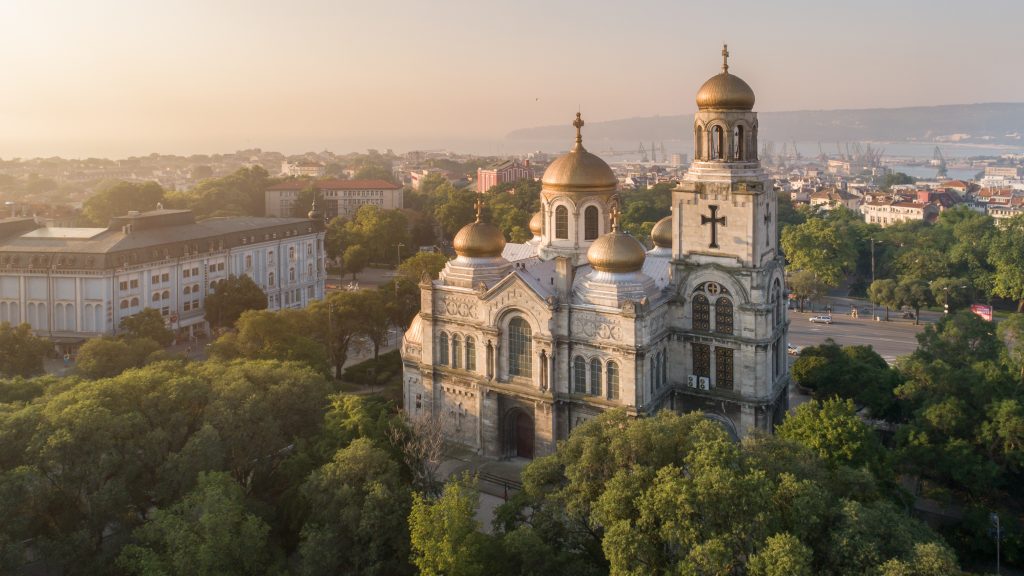
Still largely unknown to me, as well as being stunningly beautiful and hiding incredible, breathtaking views, the Vratsa Balkan is full of all kinds of little spots perfect for escaping the daily rush into the peace of nature. Rock formations, waterfalls, eco-trails, monasteries, picnic meadows, museums, National Revival history – whatever takes your fancy.
In this article I’ll tell you about a fascinating monastery we stumbled upon completely by chance. On the way back to Sofia from Cherepish Monastery, clearly too caught up in a heated conversation in the car, we missed a turning, and as we drove along the scenic roads of the Iskar Gorge we found ourselves at the gates of Osenovlak Monastery, better known as the “Seven Altars” Monastery. I’d never heard of it before, but it looked beautiful from the outside, so we decided to go in. Once again I’m convinced that nothing happens by chance!

The monastery turned out to be a really pleasant, peaceful little spot. Luckily it was almost empty, perhaps because it was already late on a Sunday afternoon. The only sound was the twittering of the birds perched in the giant sequoias in the monastery courtyard, which are seriously impressive in size. Osenovlak Monastery is a working monastery for monks, and it also offers accommodation. One of the monks, who greeted us at the entrance, was kind enough to tell us a little more about the history and legends of the holy cloister.
How to get to the monastery
The Seven Altars Monastery is about 80 km from Sofia, and you get there along the road through the Iskar Gorge. The drive takes about an hour and a half. Once you reach Eliseyna station, take the narrow tarmac road towards the village of Elenov Dol. From Eliseyna station to the monastery it’s 10 km. You can also get there by train on the main Sofia–Mezdra line, getting off at the station in the village of Eliseyna, where there’s a bus to the monastery.
The Iskar Gorge is incredibly scenic and beautiful, so whether you go by car or by train, the journey is sure to be exciting and memorable. Personally, I find nature and greenery really calming and inspiring, which is why I often pick destinations tucked away in the mountains or forests.
Right outside the monastery there’s a handy car park with room for at least twenty cars, a gazebo, a few benches and a spot to sit by the stream on the other side of the road.
History of the monastery

There are several legends about how the Seven Altars Monastery was founded. According to one, it was built in the 11th century, when seven Bessarabian boyars settled in the mountains and founded the villages of Lakatnik, Leskov Dol, Zhelen, Osenovlak, Ogoya, Ogradishte and Bukovets. According to another, the cloister was founded around the time of Peter Delyan’s uprising in 1040. When the Pechenegs invaded, his brother, known by the monastic name George, and the eldest brother, Damyan, decided to build a monastery, which they called the Seven Altars. The two became its patrons. It’s said that Peter Delyan himself ended his days here and was buried at the monastery.
Another legend says that during Ottoman rule the monastery was destroyed and burnt down. Vulchan Voivoda gathered all the rebel leaders from the area, and together they rebuilt it. The seven altars in the church were made in honour of the seven builders.
The earliest records of the monastery date from 1511. Under the Ottoman Empire it was restored twice, in 1770 and in 1815, with money from the local people. St Sophronius of Vratsa, the Metropolitan of Vratsa, celebrated the liturgy here, and in 1848 a monastery school was founded.
The monastery was a favourite of the Bulgarian classic writer Ivan Vazov, who wrote the poem “The Klepalo Sounds” about it. The writer known by the pen name Zmey Goryanin (Svetozar Dimitrov) spent the last of his days at the Seven Altars.
North of the monastery there was once a fortified settlement, part of which can still be seen today. People call it the Latin Fortress. Interestingly, the klepalo (wooden bell) of one of the monastery’s bells was made from stone taken from the walls of the ancient fortress.
The monastery is on the list of the “100 National Tourist Sites”.

[blockquote align=”none” author=”“The Klepalo Sounds” Ivan Vazov “]
“Just one memory, a wonder unknown:
here every Sunday, at the darkest dawn,
the voice of the klepalo secretly carries
through nearby valleys and silent woods.
And the startled villager lifts his eyes,
quickly crosses himself, turns that way
and timidly whispers: ‘It’s holy Sunday!
God’s monk is striking the klepalo!’”
[/blockquote]
The monastery church
The monastery church dates back to the 11th century, but not a trace of its original architecture survives today. In 1770 a master builder from Troyan thoroughly rebuilt the church, which today can be seen in its early National Revival style. The building is unique for its seven altars and has no equivalent anywhere in Bulgaria. Four main altars form a cross and are separated from the main hall by inner walls. Two more are near the door, and the seventh stands opposite the church entrance. Each “altar” forms a chapel with its own murals and iconostasis, dedicated to a Bulgarian saint.
The church has a very beautiful icon of the Nativity of the Virgin, which legend says was brought from Mount Athos.


Author
Vilislav Alkantara