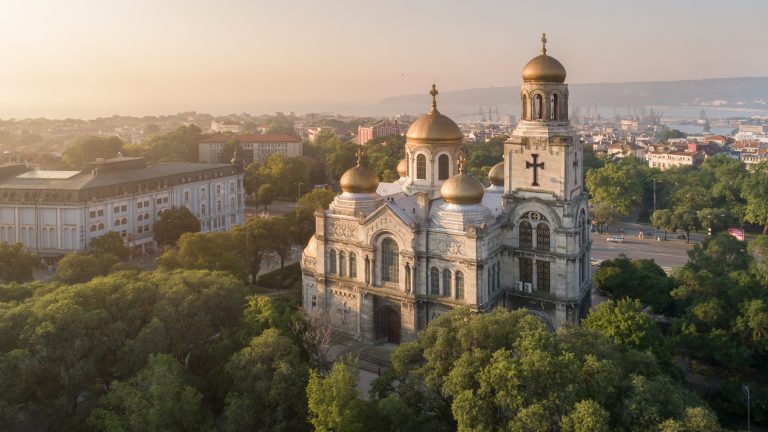

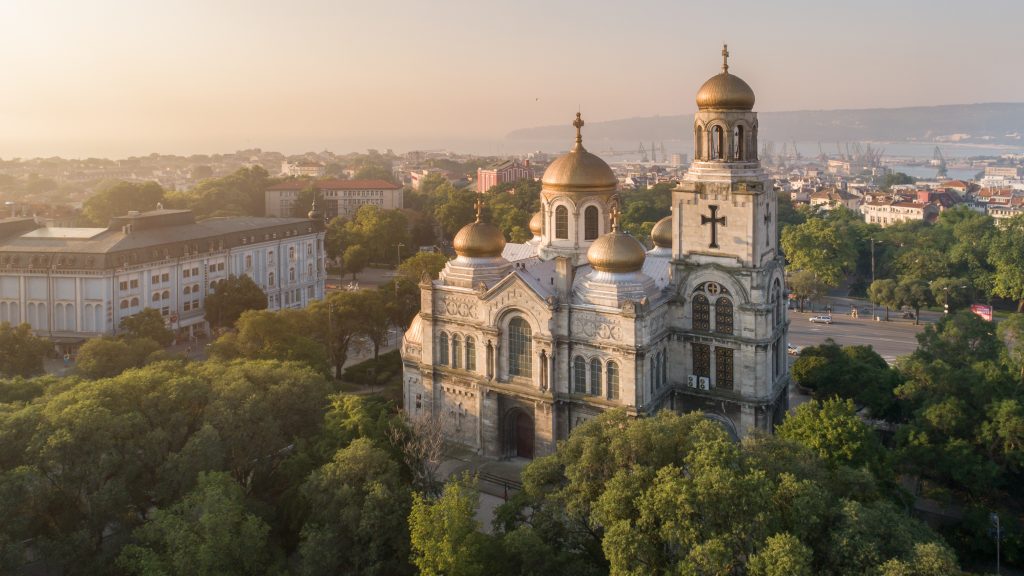
Near the village of Bachkovo, just outside Asenovgrad, stands one of the oldest monasteries in the Balkan Peninsula, a meeting point of three cultures – Byzantine, Old Georgian and Bulgarian. Bachkovo Monastery is one of the most visited and best-loved places among Bulgarians, and plenty of foreigners too, thanks to its unique ancient architecture. I’ve already told you about my visit to Asen’s Fortress, and we went to the monastery straight afterwards, before heading back to Sofia.

Once we’d parked, we set off along the lane to the monastery, which looked just like one of the streets in Sunny Beach – grills, beer, Greek music and Chinese tat. Lovely! A hundred metres or so later we were at the monastery gates. It was packed with people, even though it was nearly closing time. I was really struck by how many of the visitors were foreigners – there were groups from Greece, Germany and England.
The monastery was founded in 1083 by the Georgian Gregory Bakuriani, who paid for it to be built. For a long time it remained a Georgian monastery. All that survives from those early days is the two-storey ossuary, about 400 m away. In 1344 the region came within Bulgaria’s borders and the monastery came under the patronage of Tsar Ivan Alexander. It was he who commissioned the paintings in the ossuary’s narthex, including an imposing mural portrait of himself, along with his patron saint, John the Theologian, and Sts Constantine and Helena, and on the lower floor, “sebastos Gregory Pakourianos, servant of Christ, grand domestic and founder” alongside “magister Abasius, brother of the founder”. The Bulgarian tsar is shown in a pose typical of imperial portraits. In his right hand he holds a sceptre topped with a cross, and in his left, drawn to his chest, a scroll.

Although Bachkovo Monastery survived the first onslaught of the Turkish armies, it later shared the fate of most other Orthodox monasteries in our lands and was looted and destroyed. Work on new monastery buildings began at the end of the 16th century, and the east wing with its fortified main gate was most likely built then too. Don’t miss the refectory. As well as its unique murals, you can see an old marble table where the monks used to eat, inscribed with the year the building went up.
The monastery complex is shrouded in legends and mysteries. It’s believed that after the fall of the Tarnovo Kingdom, Patriarch Euthymius was exiled here, and later died here. Early in the last century a grave was uncovered containing bones, remnants of monastic robes and a lead plaque declaring this to be the grave of the Patriarch of Tarnovo – yet it has still not been confirmed that the remains are really his.

The monastery’s greatest treasure, and the relic that draws the most visitors, is the icon of the Mother of God, believed to be miracle-working. There are many theories about where the icon came from; it was probably brought from Georgia when the monastery was built. Since time immemorial the icon has been known to help many believers. Its miraculous power lies in helping the sick and the childless, which is why the image of the Mother of God, kept in the monastery’s little church, is considered miracle-working. That’s also why the monastery bears the name “Dormition of the Mother of God”. Of the whole painting, only the faces of the Holy Virgin and the Christ Child can be seen; everything else is covered, as a mark of reverence, by two silver casings.
Author
Vilislav Alkantara